Table of contents
Battery aging during shallow charge cycles: What role do temperature and electrode materials play?
Stationary battery storage systems are often not fully charged or discharged. Instead, they balance fluctuations between energy production and consumption. The resulting shallow charge and discharge cycles are considered relatively gentle. However, scientific studies show that a low depth of discharge does not necessarily correlate with lower battery aging.
A long-term study by Naumann et al. (2020) on lithium iron phosphate/graphite cells (LFP/graphite) showed a pronounced, partially reversible capacity loss during shallow charge cycles in medium state-of-charge ranges. The result highlights that, in addition to the depth of discharge, the average state of charge, temperature, and current load must also be taken into account.
The decisive factor is what happens inside the battery cell: Which chemical reactions actually lead to the loss of usable capacity? What role do the electrode materials play, and how can thermal changes be investigated using a battery calorimeter?
Structure and cell formats of lithium-ion batteries
To understand aging processes, a distinction must first be made between the chemical composition and the mechanical structure of a battery cell.
A lithium-ion cell essentially consists of a positive electrode, a negative electrode, an ion-conducting electrolyte, and a separator. During the charging and discharging process, lithium ions are transported between the electrodes and are intercalated into or released from electrochemically active materials.
The electrode materials used significantly determine the electrical and electrochemical characteristics of the cell. For example, LFP/graphite and NMC/graphite cells differ in terms of their electrode potentials, energy density, and aging behavior.
Regardless of the cell chemistry, there are various designs that differ primarily in geometry, housing, electrode arrangement, and mechanical stability.
Cylindrical cells, prismatic cells, and pouch cells
Cylindrical cells usually have a metallic, cylindrical housing. The electrodes and the separator are typically rolled into a coil structure. Well-known formats include 18650 and 21700. The stable housing provides mechanical protection, while the cylindrical geometry influences heat dissipation and temperature distribution.
Prismatic cells have a rectangular, predominantly rigid housing. Due to their compact design, they can be combined into battery modules to save space. Depending on the cell construction, the electrodes are stacked or wound. Prismatic cells are used in electric vehicles and stationary energy storage systems, among other applications.
Pouch cells use a flexible, multi-layer packaging film instead of a rigid metal housing. The relatively lightweight design allows for high space utilization. At the same time, the lower mechanical stability and possible changes in thickness during operation require suitable mechanical support.
Coin cells are particularly compact cells in a flat metal housing. In battery research, they are frequently used to investigate new electrode materials and electrolyte compositions in small experimental cells.
However, the cell shape alone does not determine aging. Two geometrically different cells can use the same electrode chemistry, while cells of the same design can contain completely different material systems.
Both aspects are important for thermal investigation: the cell chemistry influences heat generation, while the geometry, housing, and thermal contact conditions influence heat transfer to the measurement system.
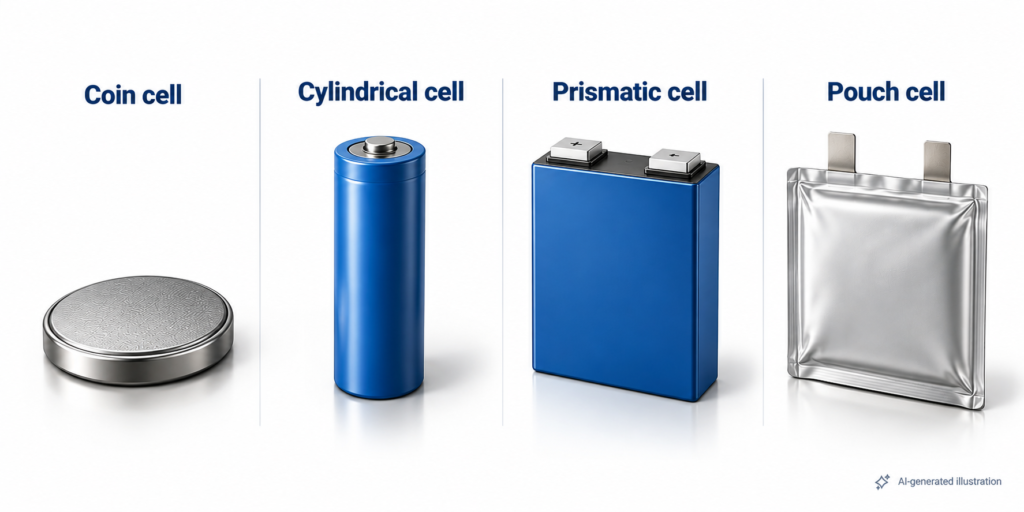
Figure 1: Comparison of the most important designs of lithium-ion battery cells.
The illustration shows coin cells, cylindrical cells, prismatic cells, and pouch cells. The designs differ in particular with regard to their geometry, housing construction, and mechanical stability. These properties influence, among other things, heat transfer and thermal contacting during calorimetric investigations. The cell chemistry is independent of the external design.
Source: Own schematic representation, created with AI support. Not to scale.
How do lithium-ion batteries age?
The aging of a lithium-ion battery cannot be attributed to a single chemical process. Several reactions and structural changes can occur simultaneously and influence each other.
The most important consequences are the loss of usable capacity and the increase in electrical or electrochemical internal resistance.
At the material level, three fundamental changes can be distinguished: the loss of cyclable lithium, the loss of electrochemically active material, and changes in transport and interface properties.
SEI growth: Lithium is chemically bound
The graphite anode plays a central role.
When a lithium-ion battery is charged for the first time, the electrolyte is partially reduced at the surface of the negative electrode. This creates solid reaction products that form a passivation layer: the so-called Solid Electrolyte Interphase (SEI).
This layer is necessary because it protects the graphite surface from further, uncontrolled electrolyte decomposition while simultaneously allowing the transport of lithium ions.
The SEI consists of various organic and inorganic compounds. Possible components include lithium carbonate (Li₂CO₃), lithium fluoride (LiF), and lithium-containing organic reaction products. Its actual composition depends, among other things, on the electrolyte and the operating conditions.
During the formation of these compounds, lithium ions are bound in reaction products. They are then no longer available for the regular exchange of charge between the positive and negative electrodes.
The lithium does not disappear from the cell, but is partially present in chemically bound form.
This process is known as Loss of Lithium Inventory (LLI). This refers to the loss of the portion of lithium available for the reversible storage and release of electrical energy.
Further reactions can occur even after the initial SEI formation. Elevated temperatures, long storage times, and changes to the electrode surface can promote additional SEI growth. In the process, lithium and electrolyte components are again bound or consumed.
Keil et al. (2016) showed that calendar aging depends, among other things, on the potential of the graphite anode. At a high state of charge, graphite is more heavily lithiated. The associated lower anode potential can promote further electrolyte reduction and SEI growth.
Lithium plating: When lithium is deposited metallically
Another aging mechanism is so-called lithium plating.
During regular charging, lithium ions are intercalated into the graphite structure. Under unfavorable conditions, however, intercalation may occur too slowly. This is possible, for example, at low temperatures, high charging currents, or with anodes that are already heavily lithiated.
Instead of fully penetrating the graphite, lithium ions can then accept electrons and deposit as metallic lithium on the anode surface.
Part of this metallic lithium can be electrochemically converted again during subsequent discharging. Other parts react with the electrolyte or lose electrical contact with the electrode.
This electrically isolated lithium is often referred to as dead lithium. It can no longer participate in the regular charging and discharging process.
Lithium plating therefore contributes to the loss of cyclable lithium and can promote further side reactions and changes to the SEI.
Metallic deposition is also safety-relevant, especially if unfavorable deposition structures develop. However, lithium plating cannot be clearly detected from a change in heat flow alone.
Mechanical damage and loss of active material
During charging and discharging, the lithium content of the electrodes changes. This can be accompanied by changes in the crystal lattice and material volume.
Repeated expansion and contraction processes can generate mechanical stress. Depending on the electrode material and cell construction, this can lead to cracks, loss of contact, or changes in the particle structure.
If active particles are electrically separated from the conductive electrode network, they can no longer fully participate in the electrochemical process despite existing lithium storage capacity.
This effect is known as Loss of Active Material (LAM).
Cracks can also expose new electrode surfaces. If electrolyte reaches these surfaces, additional interface reactions can occur. In this way, mechanical degradation and chemical aging partially reinforce each other.
Changes at the cathode and in the electrolyte
Aging processes also occur at the positive electrode.
In NMC-based cathodes, high electrode potentials and elevated temperatures can promote electrolyte oxidation, changes in the surface structure, and the dissolution of transition metals, among other things.
Dissolved metal ions can migrate through the electrolyte and influence further undesirable reactions at the negative electrode.
An interface layer, known as the Cathode Electrolyte Interphase (CEI), can also form on the cathode surface.
In LFP cells, other structural and electrochemical properties are decisive. The olivine-like LFP structure is considered relatively stable; nevertheless, interface reactions, electrolyte degradation, and the loss of cyclable lithium can also contribute to aging here.
Qiao et al. (2025) investigated LFP/graphite pouch cells at different temperatures and states of charge. Under the conditions considered, higher temperatures and higher states of charge led to greater capacity loss.
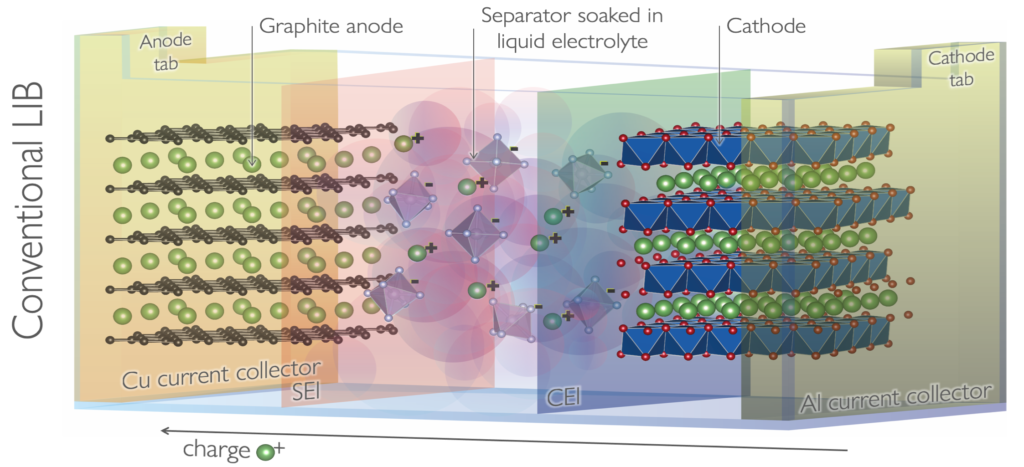
Figure 2: Schematic structure of a conventional lithium-ion cell and a solid-state battery.
The illustration shows the basic structure of both cell concepts with electrodes, current collectors, and electrolytes, as well as the SEI and CEI interface layers. The figure serves to illustrate the cell structure and does not represent a specific LFP/graphite cell chemistry.
Source: Amiri, A. K.; Morgan, L. M.; Michael, M. P.; Edge, J. S. (2021): Structures of conventional and solid state lithium ion batteries. Zenodo. DOI: 10.5281/zenodo.5013913.
Calendar and cyclic aging
The chemical and mechanical processes mentioned can occur both during storage and in active operation.
In calendar aging, temperature, storage duration, and state of charge play a particularly important role. A cell can therefore lose capacity even if it is hardly used over a long period of time.
In cyclic aging, stresses from repeated charging and discharging are added. These include concentration changes within the electrodes, mechanical stresses, and current loads.
The two forms of aging cannot be completely separated from each other in real operation. For example, a cell can age simultaneously through time-dependent SEI growth and through repeated electrode stress during a cycle test.
Shallow charge cycles: Why a low depth of discharge is not always enough
The depth of discharge (DoD) describes the proportion of usable capacity that is converted during a charging or discharging process.
In shallow cycles, the state of charge (SoC) only changes within a limited range. A storage system that is operated between 40 and 60% SoC, for example, undergoes a charge swing of 20 percentage points.
Shallow cycles can reduce mechanical stress compared to larger charge swings. However, their actual aging effect also depends on the average state of charge, the temperature, and the current profile.
Naumann et al. (2020) investigated commercial LFP/graphite cells under different operating conditions over 29 months. Among other things, they observed a pronounced, partially reversible capacity loss during shallow cycles in medium state-of-charge ranges.
Such a capacity loss does not therefore have to be equated entirely with irreversible chemical changes. Relaxation processes and the conditions of the reference measurement can also influence the measured capacity.
This does not mean that deep cycles are fundamentally more favorable. For a reliable assessment, depth of discharge, SoC window, temperature, current load, and energy throughput must be considered together.
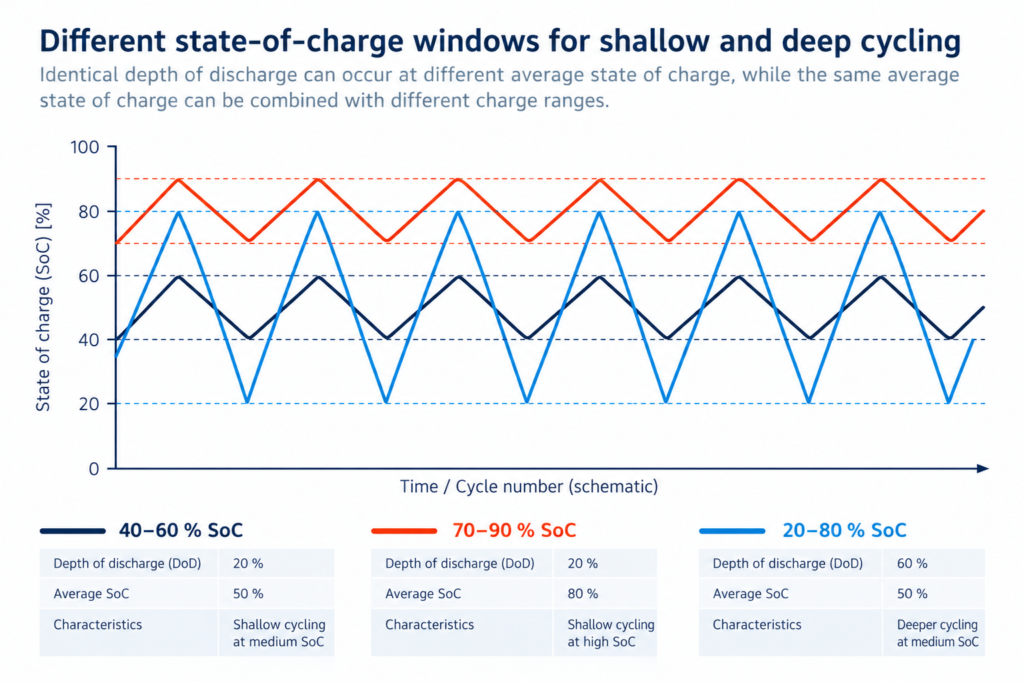
Figure 3: Comparison of different state-of-charge windows for shallow and deep charge cycles.
The schematic representation illustrates that identical depths of discharge (DoD) can occur at different average states of charge (SoC). Conversely, different charge swings can have the same average SoC. To evaluate battery aging, both influencing variables must therefore be taken into account.
Source: Own schematic representation, created with AI support. No experimental measurement data.
What does a battery calorimeter measure?
During charging and discharging, thermal effects occur in a battery cell in addition to electrical and electrochemical processes.
A battery calorimeter measures the heat flow that is transferred from a battery cell to its surroundings or to the measurement system during defined operating conditions.
In an isothermal battery calorimeter, the cell is investigated under the most constant, controlled temperature conditions possible. The dissipated heat flow is recorded with time resolution.
Unlike a pure temperature measurement, this does not just observe how much the cell heats up. Calorimetry provides quantitative information about the thermal energy exchange.
Which thermal effects occur during operation?
The heat generation of a battery is composed of several contributions.
Irreversible heat is generated, among other things, by ohmic resistance and electrochemical polarization. These losses depend, for example, on current strength, cell state, and temperature.
Reversible heat is associated with entropic changes in the electrochemical cell reaction. Depending on the state of charge and current direction, this heat contribution can be exothermic or endothermic.
Parasitic heat flow can be caused by undesirable side reactions, for example, by progressive electrolyte decomposition or interface reactions.
The fundamental energy balance of such processes was described by Bernardi, Pawlikowski, and Newman (1985).
For interpretation, it is crucial that the calorimeter initially measures the superimposed total thermal contribution. Individual reactions cannot be clearly identified solely on the basis of a specific heat flow value.
However, the different heat contributions can be investigated in more detail using suitable measurement protocols, accompanying electrical measurements, and physical models.
What can the LINSEIS IBC L91 measure?
The LINSEIS IBC L91 is an isothermal battery calorimeter for investigating the heat flow of battery cells under controlled temperature conditions.
The measurement system works with temperature-controlled measuring plates and heat flow sensors. The battery is thermally coupled to the measurement arrangement, while its charging and discharging behavior is specified via a suitable electrical source or a battery cycler.
The measured heat flow can be evaluated together with current, voltage, and temperature data.
This allows, for example, the influence of different C-rates, state-of-charge windows, and measurement temperatures, as well as changes in thermal behavior over repeated measurements, to be investigated.
The measuring cell of the IBC L91 has a modular design and can be adapted to different cell sizes and geometries.
The system supports coin cells and cylindrical cells, for which corresponding adapters are available. Flat pouch cells and prismatic cells can also be investigated with a suitable measuring plate configuration.
The specific suitability depends on cell dimensions, thermal contacting, measuring plate geometry, and the expected heat flow.
What information does the measurement provide?
Various information can be obtained from time-resolved heat flow data.
For example, it can be investigated how heat generation changes at different charging and discharging currents. At the same time, defined temperature conditions can serve to make differences in thermal cell behavior visible.
By integrating the heat flow over a specified period of time, the corresponding thermal energy exchange can be determined.
Together with the electrical measurement data, such results can contribute to the evaluation of the energy balance of a battery cell.
For interpretation, however, the sign convention of the heat flow, the dynamic response of the measurement system, and the correction and calibration procedures used must be taken into account.
How can battery aging be investigated with a calorimeter?
A battery calorimeter does not measure the aging of a cell directly as a single physical quantity. However, it provides additional information about thermal changes that can be related to electrochemical and chemical processes.
For an aging study, for example, a comparison of identical cells under defined operating conditions is useful.
First, the initial thermal state of a cell is characterized. For this purpose, heat flow measurements can be carried out during a standardized charging and discharging profile.
The cell is then stressed over a specified number of cycles or stored for a longer period at a defined state of charge and temperature.
The same calorimetric measurement program is repeated at regular intervals.
If the heat flow changes at a comparable SoC, the same temperature, and the same current load, this indicates that the thermal or electrochemical behavior of the cell has changed.
The causes can be, for example, an increased internal resistance, changed polarization losses, or additional side reactions.
Can SEI growth and lithium plating be measured directly?
Isothermal calorimetry can contribute to the investigation of reactions related to SEI growth, electrolyte degradation, or lithium plating.
However, the assignment is challenging.
During SEI growth, chemical side reactions can generate additional heat. The corresponding signals can be very small and overlap with reversible and irreversible heat contributions.
Downie, Hyatt, and Dahn (2016) showed using NMC442/graphite cells that isothermal microcalorimetry can detect differences in parasitic reactions between different electrolyte systems.
Lithium plating can also influence the thermal behavior of a cell. However, a characteristic heat flow curve alone does not prove that lithium has been metallically deposited.
For a clear assignment, supplementary methods are required, such as electrochemical impedance spectroscopy, special voltage relaxation analyses, or material analysis investigations.
The battery calorimeter thus does not provide direct chemical identification of all aging reactions, but rather an additional experimental approach to their thermal effects.
Practical example: Heat flow at different charging and discharging currents
An application example of the LINSEIS IBC L91 shows the heat flow of a single lithium-ion battery cell as a function of the converted capacity at different C-rates.
The measurements were carried out at 0.4 C, 0.6 C, and 0.8 C.
The curves illustrate that the current load affects the heat flow profile. In the experiment shown, larger heat flows occur at higher charging and discharging currents. At the same time, the capacities achieved in each case differ.
The study thus shows how different electrical operating conditions can be compared calorimetrically.
However, a direct statement about the long-term aging rate is not possible from this single measurement. This would require repeated measurements and additional information on capacity and impedance development.

Figure 4: Influence of different charging and discharging currents on the heat flow of a lithium-ion battery.
The heat flow is shown as a function of the converted capacity of a single lithium-ion battery cell at different C-rates (0.4 C, 0.6 C, and 0.8 C). The measurement curves show that the current load influences both the heat flow profile and the capacity achieved. In particular, larger heat flows occur at higher charging and discharging currents. The results illustrate the relationship between electrical load, thermal behavior, and usable capacity. For a quantitative determination of the energetic efficiency, additional electrical energy data and a corresponding heat balance are required.
Source: Own measurements, LINSEIS MESSGERAETE GMBH.
How can the aging of stationary battery storage systems be reduced?
The results of scientific aging studies show that the service life of stationary lithium-ion storage systems can be influenced by a suitable operating strategy.
An important starting point is temperature management. Elevated temperatures can accelerate numerous undesirable chemical side reactions. At the same time, temperatures that are too low must be taken into account when choosing the charging profile, as they can promote lithium plating under unfavorable conditions.
The state-of-charge window also plays an important role. Longer residence times at high states of charge can promote calendar aging in particular. The appropriate limit values depend on the cell chemistry used and the application profile.
When choosing the charging and discharging currents, thermal load and desired performance must be weighed against each other. High currents can lead to increased irreversible heat losses and, under certain conditions, promote additional aging mechanisms.
Finally, the depth of discharge should not be considered in isolation. Shallow charge cycles can be advantageous, but their effect depends on the average state of charge and other operating conditions.
Calorimetric measurements can contribute to quantitatively comparing the heat generation of different operating strategies. In conjunction with electrochemical aging tests, they thus provide an additional basis for the development of long-lasting battery storage systems.
Conclusion: Understanding battery aging at the material and cell level
The aging of lithium-ion batteries results from the interplay of chemical, electrochemical, and mechanical processes. These include, in particular, the growth of interface layers, the irreversible binding of lithium, metallic lithium deposition, and the loss of electrochemically active material.
Shallow charge cycles can reduce stress, but do not automatically guarantee a low aging rate. The cell chemistry and the combination of temperature, state of charge, current load, and depth of discharge are decisive.
Battery calorimetry complements electrical and electrochemical investigations with time-resolved information on heat generation. The LINSEIS IBC L91 makes it possible to investigate such thermal changes under defined operating conditions and to relate them to electrical measurement data.
Only by combining calorimetric results with suitable aging and material analyses can the underlying degradation processes be evaluated more comprehensively and operating strategies be specifically improved.
Scientific literature
- Naumann, M.; Spingler, F.; Jossen, A. (2020): Analysis and modeling of cycle aging of a commercial LiFePO₄/graphite cell. Journal of Power Sources, 451, 227666. https://doi.org/10.1016/j.jpowsour.2019.227666
- Keil, P. et al. (2016): Calendar Aging of Lithium-Ion Batteries: I. Impact of the Graphite Anode on Capacity Fade. Journal of The Electrochemical Society, 163(9), A1872–A1880. https://doi.org/10.1149/2.0411609jes
- Qiao, X. et al. (2025): Deciphering the Calendar Aging Degradation Mechanism of LiFePO₄–Graphite Pouch Cells. ACS Applied Energy Materials, 8(4), 2209–2218. https://doi.org/10.1021/acsaem.4c02761
- Wang, J. et al. (2014): Degradation of lithium ion batteries employing graphite negatives and nickel–cobalt–manganese oxide + spinel manganese oxide positives: Part 1, aging mechanisms and life estimation. Journal of Power Sources, 269, 937–948. https://doi.org/10.1016/j.jpowsour.2014.07.030
- Downie, L. E.; Hyatt, S. R.; Dahn, J. R. (2016): The Impact of Electrolyte Composition on Parasitic Reactions in Lithium Ion Cells Charged to 4.7 V Determined Using Isothermal Microcalorimetry. Journal of The Electrochemical Society, 163(2), A35–A42. https://doi.org/10.1149/2.0081602jes
- Bernardi, D.; Pawlikowski, E.; Newman, J. (1985): A General Energy Balance for Battery Systems. Journal of The Electrochemical Society, 132(1), 5–12. https://doi.org/10.1149/1.2113792
- Edge, J. S. et al. (2021): Lithium ion battery degradation: what you need to know. Physical Chemistry Chemical Physics. https://doi.org/10.1039/D1CP00359C
- Fraunhofer ISI (2022): Development perspectives for lithium-ion battery cell formats. https://www.isi.fraunhofer.de/content/dam/isi/dokumente/cct/2022/Development_perspectives_for_lithium-ion_battery_cell_formats_Fraunhofer_2022.pdf
- LINSEIS Messgeräte GmbH: IBC L91 – Isothermal Battery Calorimeter. Technical product documentation. https://www.linseis.com/en/products/calorimetry/ibc-l91-isothermal-battery-calorimeter/