


Table of contents
Ethylene-vinyl acetate (EVA) is a soft, semi-crystalline copolymer that impresses with its high flexibility, excellent damping properties and an exceptionally wide property window – precisely where classic polyethylenes, rigid thermoplastics or brittle elastomers reach their limits. By specifically adjusting the vinyl acetate content (VA) and the degree of cross-linking, EVA can be adjusted from transparent-soft to structurally stable and highly damping. This makes it the first choice in areas such as shoe soles, damping elements, solar encapsulants and flexible films. [1]
Crystallinity: the key to flexibility and damping
EVA is a random copolymer of ethylene and vinyl acetate in which the VA content significantly interferes with the crystallization of the polyethylene segment. As the VA content increases, the crystalline content decreases from around 50-60% in pure PE to almost amorphous structures at around 40% VA by weight, making the material significantly softer and more rubbery. [2]
The crystallinity controls both stiffness and resilience: higher crystallinity provides mechanical strength, while lower crystallinity leads to pronounced damping and energy absorption – a key reason why EVA performs so well under cyclic loads, for example in sports shoes or vibration pads. In cross-linked EVA networks (cEVA), the crystalline domains can also be used as physical anchor points, improving strength and dimensional stability even at higher temperatures. [1]
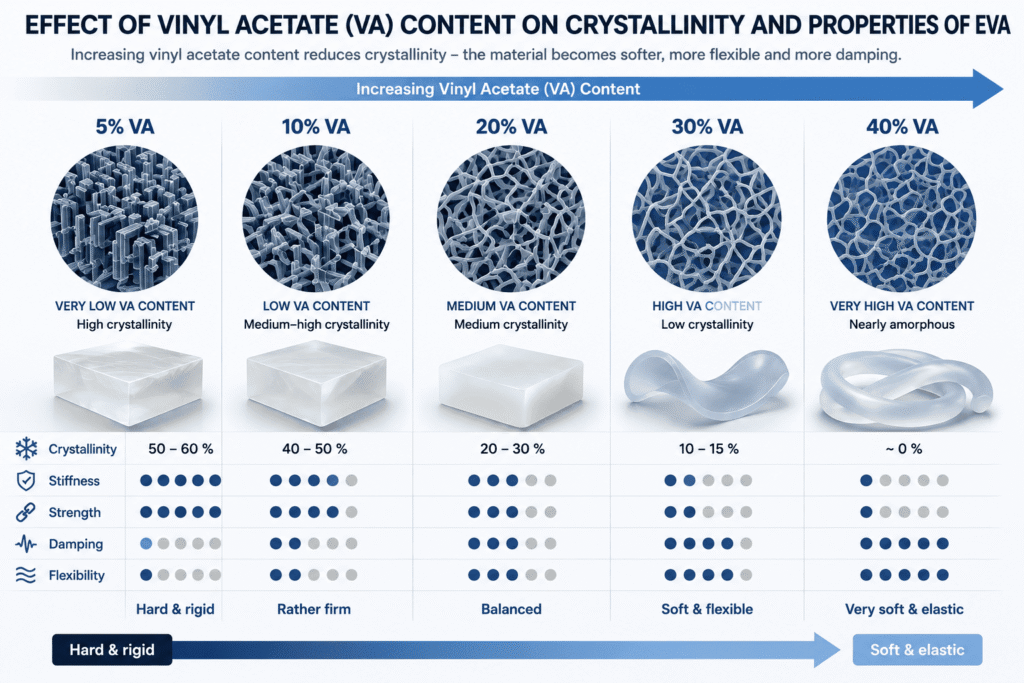
Visualization created with AI-based image generation.
Melting point and thermal processability
The melting point of EVA is directly linked to the crystallinity and thus to the VA content. While crystalline, PE-rich EVA grades have melting peaks in the range of around 110-120 °C, the melting range shifts to a wider, significantly lower interval of around 40-60 °C at high VA contents (around 40 wt.%). [2]
In practice, this means that EVA grades with a moderate VA content combine a sufficiently high melting point for thermal resilience with good processability in extrusion, injection molding or foaming processes. In cross-linked EVA systems, the classic melting point becomes less important as the chemical cross-linking prevents complete flow – the thermal transitions, however, remain in the DSC signal visible. [1]
Glass transition temperature and attenuation behavior
The glass transition temperature (Tg) of EVA is typically between about -25 °C and -30 °C, depending on VA content and network morphology, whereby the influence of VA content on Tg is comparatively low. Dynamic mechanical analyses (DMA) also show two relaxation processes: a deep relaxation around approx. -90 °C, which is assigned to amorphous PE segments, and a further relaxation between approx. -50 °C and +30 °C with a pronounced damping maximum between -32 °C and -3 °C. [1]
These relaxation processes are decisive for the damping behavior: In the area of the loss factor maximum, EVA shows particularly high energy absorption and vibration damping – a key reason for its use in sports shoes, protective padding and acoustic applications. If components are specifically operated in the temperature window of the main relaxation, damping can be maximized without having to switch to separate elastomers. [5]
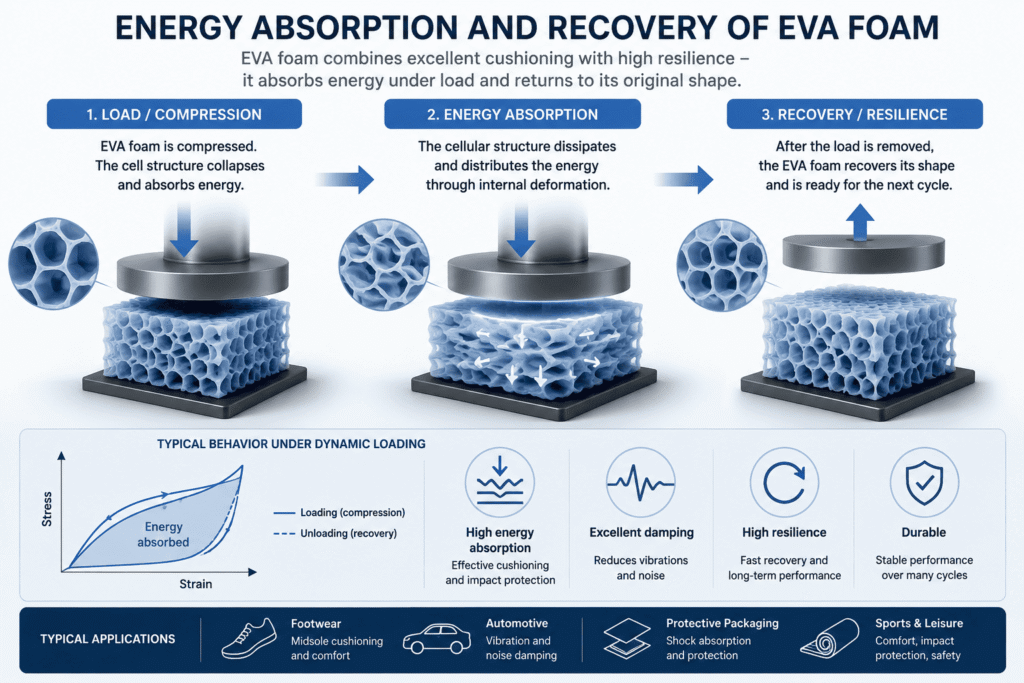
Visualization created with AI-based image generation.
Thermal stability and degradation mechanisms
Thermogravimetric investigations show a two-stage thermal degradation for EVA: First, deacetylation of the VA segments occurs between approx. 300-410 °C, followed by chain degradation of the ethylene backbone between approx. 420-510 °C.
This mechanism explains why EVA can be processed safely at moderate processing temperatures (typically below 250 °C), but tends to release acetic acid and cause structural degradation when exposed to excessive thermal stress. [1]
The thermal stability can be significantly improved by using suitable stabilizers and cross-linking, which enables use in photovoltaic laminates, cable insulation and technical foams at elevated temperatures. In dynamically thermomechanically stressed applications, cross-linked EVA grades ensure stable module and damping properties over an extended temperature range. [4]
Chemical, UV and mechanical resistance
Chemically, EVA shows good resistance to water, many polar media and aqueous solutions; there are limitations to strongly oxidizing chemicals or certain organic solvents. Compared to pure PE adhesion and compatibility with fillers – an important advantage for compounds, adhesives and composite systems. [4]
Under UV exposure, ageing processes such as yellowing, brittleness and changes in mechanical properties occur, particularly with prolonged exposure. These effects are strongly influenced by the additive package: formulated EVA grades with suitable UV absorbers and antioxidants achieve significantly improved long-term resistance and are therefore suitable for outdoor applications such as PV modules, outdoor soles and seals. [3]
Mechanically, EVA is characterized by high impact strength, good tear resistance and excellent resilience, especially with medium to high VA contents and/or cross-linking. The combination of a soft matrix and cross-linked structures enables simultaneous damping and dimensional stability – a property profile that other commodity thermoplastics often do not cover. [4]
EVA variants: From low VA content to hotmelt
The variability of EVA is based on three central control variables: VA content, molecular weight distribution and degree of crosslinking. [ 4] Typical grades can be roughly divided into three groups: EVA with a low VA content (approx. 4-10 %) behaves more like PE, is semi-crystalline and offers a good compromise between strength and flexibility. Medium VA contents (approx. 10-28 %) provide highly flexibilized materials with improved transparency and damping – typical qualities for films and foams. [ 2] High VA contents (≥ 30-40 %) result in almost amorphous, rubber-like materials with very good energy absorption and adhesion, which are often used in adhesive systems. [5]
Chemical cross-linking, for example using peroxide, creates cEVA networks with increased thermal dimensional stability, higher modulus and improved long-term durability – a key design principle for EVA encapsulants in photovoltaic modules. EVA blends with polyolefins or biopolymers such as PLA reduce brittleness and specifically increase toughness and damping without fundamentally changing the processing concept.
Typical fields of application: Where EVA shows its strengths
The combination of a soft, semi-crystalline structure, low Tg, adjustable cross-linking and good adhesion makes EVA the preferred material in damping and flexible applications. [5]
Shoe soles and insoles: EVA foams offer light weight, high energy absorption and low-fatigue cushioning – especially in sports shoes and orthopaedic insoles. Sports and leisure articles such as mats, protective pads and swimming aids benefit from the soft feel, pleasant compressibility and robust resilience. Vibration and oscillation dampers in machines, vehicles or electronics utilize the wide damping window of EVA as well as the possible combination of thermal stability and flexibility. [5]
Photovoltaic encapsulants made of cross-linked EVA encapsulate solar cells, protect against moisture, mechanical stress and UV light and ensure defined module elasticity. [ 4] Cable insulation utilizes the electrical insulation capability, flexibility at low temperatures and chemical resistance of EVA. EVA-based hotmelt adhesives combine adhesion, toughness and processing safety and are widely used in the packaging, wood and construction sectors. [5]
In many of these scenarios, low temperature dependency of damping, low Tg and adaptable cross-linking determine whether components still function reliably even after millions of load cycles – and this is where EVA shows its strengths over more brittle thermoplastics or elastomers that are difficult to process. [5]
Instrumental characterization of EVA
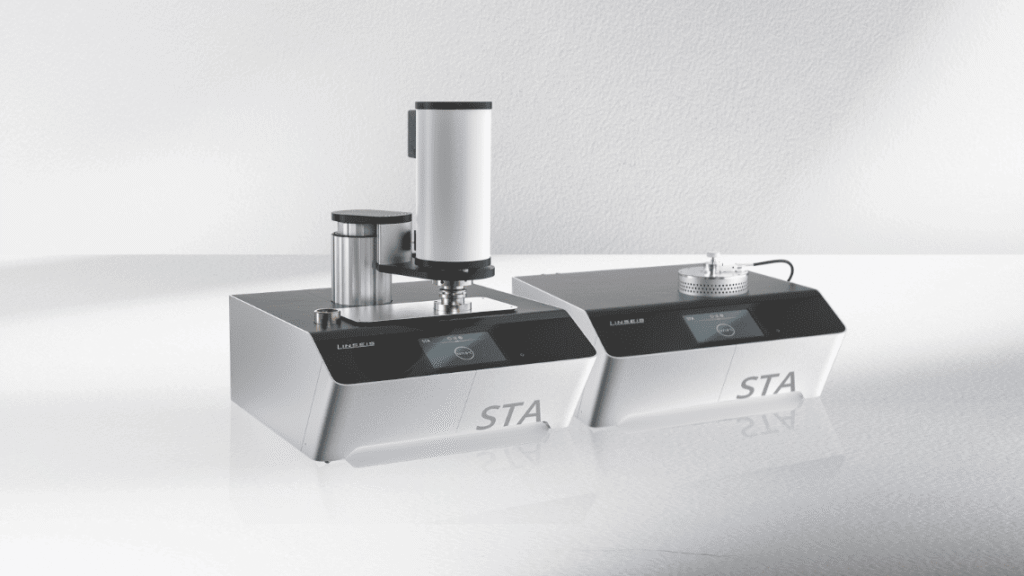
For laboratory users who want to optimize EVA grades specifically for flexibility, damping and thermal resistance, comprehensive thermal analyses are essential. With the Simultaneous Thermal Analysis (STA, TGA-DSC), melting processes, crystallinity, glass transitions and two-stage thermal decomposition (deacetylation, backbone degradation) can be determined and directly correlated in a single measurement run. In addition, DSC systems offer a high-resolution analysis of melting and crystallization behaviour, Tg and enthalpies, while dilatometry and thermophysical measurement methods support the design of EVA components with regard to thermal expansion and heat transfer. On this basis, researchers and engineers can precisely adapt EVA formulations to their application requirements – in terms of flexibility and damping as well as long-term and process stability.
Bibliography
[1] Li, G. et al. (2019): “The thermal and mechanical properties of poly(ethylene-co-vinyl acetate) copolymers and their crosslinked analogs.” Polymers. PMC6631310.
https://pmc.ncbi.nlm.nih.gov/articles/PMC6631310/
[2] Gétenga, C. et al. (2019): “Viscoelasticity evolution of ethylene-vinyl acetate copolymers.” Chemical Engineering Transactions, Vol. 74, pp. 183-188.
https://www.aidic.it/cet/19/74/183.pdf
[3] Jin, J. et al. (2010): “UV aging behavior of ethylene-vinyl acetate (EVA) copolymers with different vinyl acetate contents.” Polymer Degradation and Stability.
https://www.sciencedirect.com/science/article/abs/pii/S0141391010000911
[4] Renner, K. et al. (2022): “Comparison of the crosslinking kinetics of UV-transparent EVA and POE encapsulants.” Polymers. PMC9003555.
https://pmc.ncbi.nlm.nih.gov/articles/PMC9003555/
[5] Sinocure Chemical (2024): “Applications, benefits and strategies to prevent aging and yellowing in cross-linked EVAs.”