


Table of contents
Today, High Entropy Alloys (HEAs) are regarded as the central material class for high-performance applications in aerospacepower generation and turbine and reactor construction. Due to their complex, multi-component composition, they exhibit unique combinations of high strength, temperature and oxidation resistance. oxidation resistance – but at the same time they are extremely difficult to characterize. Precise thermal analysis and the determination of thermophysical properties are therefore crucial enablers for the targeted development and simulation of HEAs and their transfer to industrial applications (Odetola et al., 2024).
What are High Entropy Alloys?
High entropy alloys – also known as multi-principal element alloys or complex concentrated alloys – typically consist of at least five main elements in the range of 5-35 at.%. In contrast to classical alloys with a dominant base element (e.g. Ni, Co or Fe conductive metal), the properties of HEAs are determined by the mixing and entropy effect of several elements (Odetola et al., 2024). The high configurational entropy often stabilizes simple solid solution phases (FCC, BCC, HCP) and leads to a variety of “core effects” such as strong lattice distortion, sluggish diffusion and synergistic property effects (“cocktail effect”).
HEAs are particularly interesting for high-performance applications because they offer an exceptional balance of strength, toughness, temperature stability and often also improved oxidation and wear resistance (Odetola et al., 2024; Liu et al., 2023). Typical areas of application are turbine blades, reactor and combustion chamber components as well as high-temperature structural components, where conventional superalloys reach their limits.
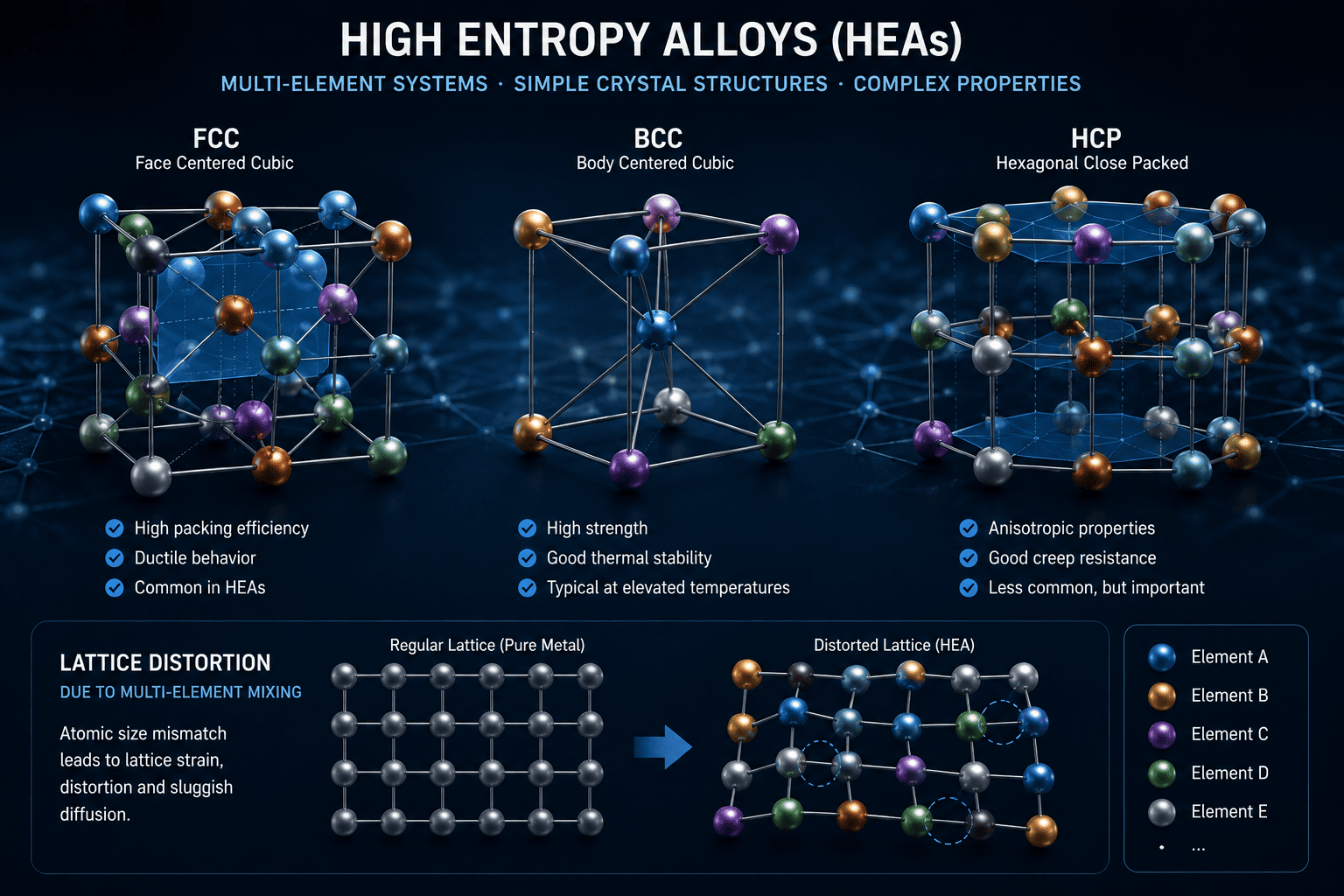
Visualization created with AI-based image generation.
Why thermal analysis is crucial for HEAs
Dealing with multi-component systems generates extremely complex, sometimes vaguely defined phase diagrams. Without sound thermal analysis, phase transitions, stability ranges and reaction behavior can hardly be reliably predicted. Thermal analysis therefore provides the basis for a reliable material evaluation and for the validation of thermodynamic models (CALPHAD, entropy calculations) (Odetola et al., 2024).
The temperature dependence of phase stability and diffusion behavior is particularly critical for HEAs:
- Phase stability in HEAs is largely dominated by the entropy contribution; with increasing temperature, simple solid solutions often stabilize at the expense of complex intermetallic or Laves phases (Odetola et al., 2024).
- Diffusion behavior is significantly delayed in HEAs (“sluggish diffusion”), which favors the formation of fine, stable nanoprecipitates and high creep stability (Odetola et al., 2024).
- Reaction behavior and oxidation are strongly dependent on temperature, atmosphere and composition; thermal analysis under inert gas or air provides decisive information on oxidation and decomposition processes (e.g. by STA measurements).
Without thermal analysis, temperature stability, phase behavior and thus also the process windows for casting, heat treatment or additive additive manufacturing cannot be reliably defined – a reliable material evaluation is then not possible (Odetola et al., 2024).
Relevant measurement methods for HEAs
Differential Scanning Calorimetry (DSC)
DSC is a key technique for the determination of phase transitions, melting and solidification curves as well as heat capacity in HEAs. The metallurgy of HEAs often shows several superpositions of phase transformations (e.g. FCC-↔-BCC, formation or dissolution of Laves or γ’ phases), which show up in DSC curves as endothermic or exothermic peaks (Odetola et al., 2024; Liu et al., 2023).
By integrating DSC curves, the molar heat capacity heat capacity can be determined, which in turn provides insights into the thermal entropy and stability of the solid solution phases (Odetola et al., 2024). DSC-based characterization also supports the selection of parameters for heat treatment processes (annealing, aging) and the identification of solution annealing temperatures for γ’ or Laves phases (Liu et al., 2023).
Simultaneous thermal analysis (STA / TGA-DSC)
STA measurements (combined thermogravimetry and calorimetric analysis) provide mass and heat data at the same time and are useful for assessing the thermal stability and oxidation behavior of HEAs. In HEAs, mass (e.g. due to oxidation or decomposition reactions) and phase state often change in the same temperature range, so that a coupled measurement makes interpretation much easier (Odetola et al., 2024; Liu et al., 2023).
Typical STA applications:
- Determination of oxidation starting points and mass loss at high temperatures (e.g. 800-1200 °C).
- Identification of decomposition or desorption effects, e.g. in coatings or low-oxide alloys.
- Determination of thermal stability and equilibrium temperatures for phase formation.
The STA thus provides a direct database for the selection of shielding gas or air atmospheres in manufacturing and operating processes.
Laser Flash Analysis (LFA)
The laser flash analysis enables the determination of thermal diffusivity and – derived from this – the thermal conductivity over a wide temperature range. HEAs often show unusual mixtures of moderate to low thermal conductivity and high mechanical stability, which is particularly interesting for thermal design (Liu et al., 2023; Odetola et al., 2024).
The LFA method is particularly suitable for dense, homogeneous HEA samples and provides important input data for thermal simulations:
- Thermal diff usivity describes how quickly a temperature field is established in the sample.
- Thermal conductivity (λ) is usually calculated from diffusivity, specific heat and density and is decisive for the design of cooling strategies (e.g. in turbine blades or reactor components).
The combination of DSC (for cpc_pcp) and LFA (for \(a\)) enables a complete, temperature-dependent thermophysical characterization of HEAs.
Dilatometry
The dilatometry measures the change in length of HEA samples with temperature and thus provides direct information on the thermal expansion (CTE) and phase transformations. HEAs with complex phase landscapes (FCC/BCC mixed structures, eutectic or lamellar microstructures) often show nonlinear CTE curves, which appear as kinks or plateaus in dilatometer data (Liu et al., 2023; Odetola et al., 2024).
Typical applications:
- Determination of the coefficient of linear expansion (CTE) in relevant temperature ranges.
- Identification of phase transformations (e.g. BCC formation, Laves sheath, γ’-solution).
- Investigation of sintering and diffusion processes, especially in additively manufactured or compacted HEA samples.
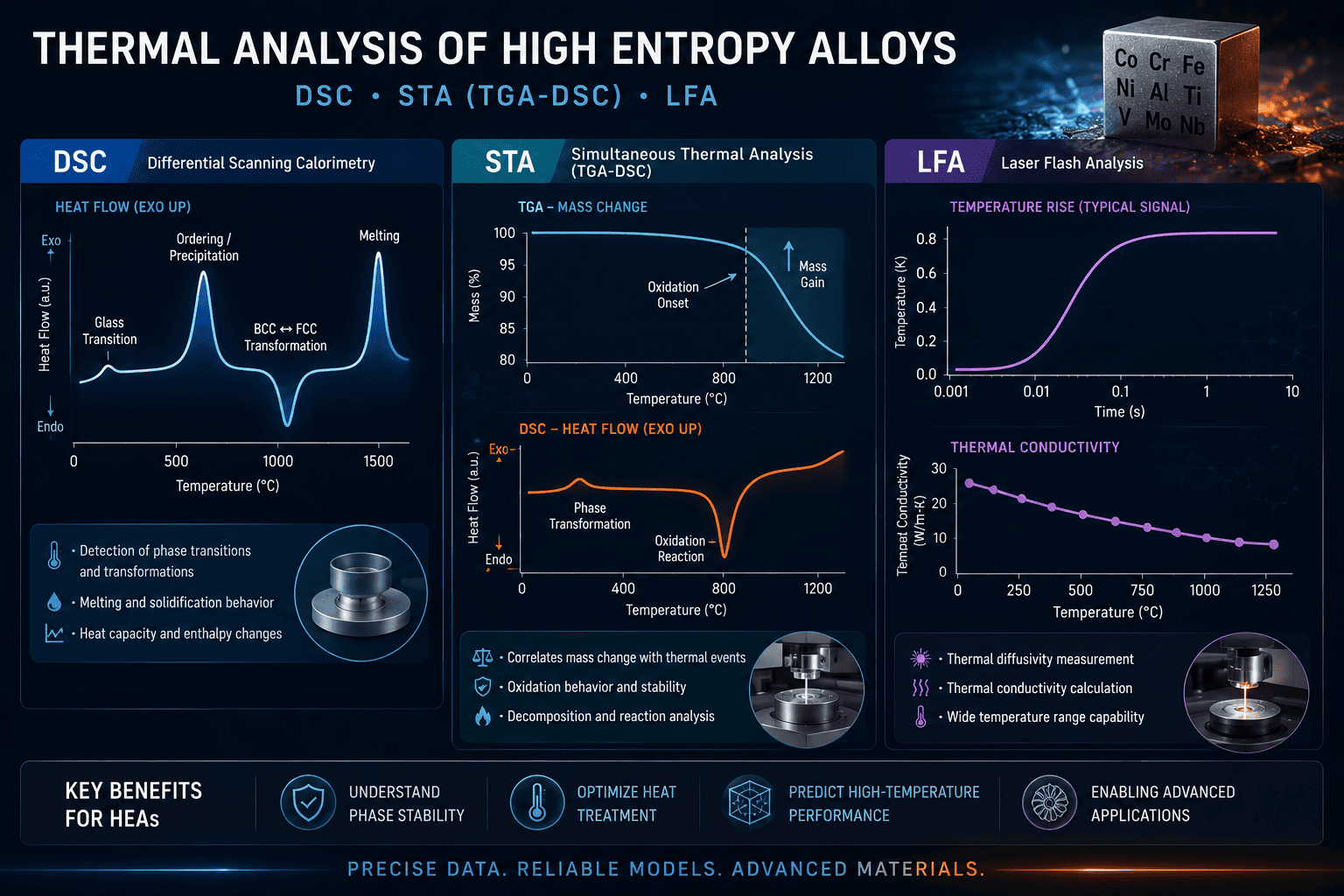
Visualization created with AI-based image generation.
Important thermophysical properties of HEAs
HEAs combine a variety of thermophysical properties that result directly from their multi-component structure and the aforementioned “core effects”:
- Thermal conductivity often low to moderate, due to disturbed heat conduction pathways and increased phonon scattering (Liu et al., 2023).
- Thermal diffusivity can vary depending on the microstructure; lamellar or nanoscale phases are generally less thermally conductive.
- Thermal/specific heat is determined via DSC and is used to calculate thermal entropy and Gibbs energy (Odetola et al., 2024).
- Thermal expansion (CTE) is frequency- and stress-dependent and can differ greatly from conventional alloys in HEAs.
- Oxidation resistance is largely determined by the formation of complex, multi-component oxide layers, which exhibit better long-term stability in many HEAs than in classical superalloys (e.g. Ni-based systems) (Liu et al., 2023).
Refractory HEAs (RHEAs) in particular show a common pattern: high strength and creep resistance combined with moderate to low thermal conductivity – a very attractive profile for high-temperature components (Liu et al., 2023; Odetola et al., 2024).
Typical applications of HEAs
The outstanding thermal and mechanical properties of HEAs make them very attractive for high-performance applications:
- Turbines & high temperature components: HEAs are being investigated for turbine blades, combustor components and high-temperature piping; their combination of high strength and oxidation-resistant surface is advantageous over classical superalloys (Liu et al., 2023).
- Nuclear technology: The temperature- and radiation-stable structure of many HEAs and their improved resistance to corrosion and oxidation in aggressive environments make them interesting for fuel cladding and structural components (Odetola et al., 2024).
- Wear-resistant coatings: HEA coatings show excellent thermal stability and high wear resistance, e.g. in high temperature tribology applications (Liu et al., 2023).
- Energy systems: High-temperature HEAs are being researched for high-temperature heat storage, reactor components and turbomachinery in high-temperature power plants and hypersonic drives (Odetola et al., 2024).
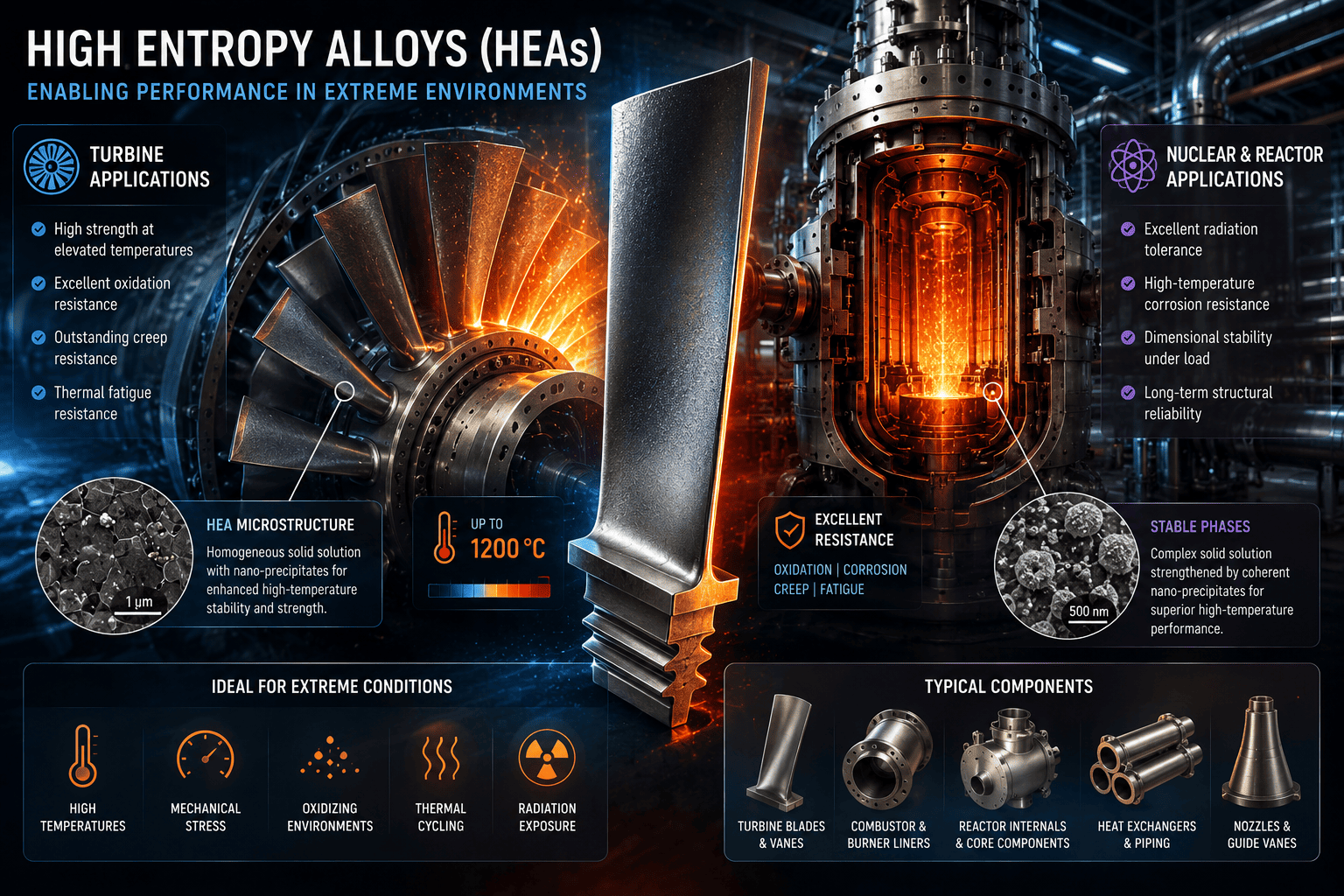
Visualization created with AI-based image generation.
Measurement requirements in the laboratory
The characterization of HEAs in the laboratory requires a variety of specific requirements:
- High temperatures (>1000 °C, sometimes up to 1500-1600 °C) are necessary to capture relevant phase and diffusion ranges.
- Inert gas and vacuum conditions are essential to prevent unwanted oxidation or contamination.
- Sample preparation must ensure maximum homogeneity, as thermal analysis relies on chemically homogeneous and structurally uniform samples.
- Reproducibility is crucial; many HEAs exhibit phase behavior that is highly dependent on temperature and time profiles, which is why standardized measurement protocols and automated systems are required.
A combination of DSC, STA, LFA and dilatometry measurements provides a complete, multidimensional characterization, which is essential for the development and validation of HEAs (Odetola et al., 2024; Liu et al., 2023).
Conclusion
Thermal analysis is a key driver for the development and industrial use of high-entropy alloys. Without precise thermal and thermophysical data, phase transitions, temperature stability and long-term behavior of HEAs can neither be simulated nor safely transferred to technical applications. The combination of several measurement methods – DSC, STA, LFA, dilatometry – provides a comprehensive view of the thermal dimension of HEAs and supports the development of high-temperature components in aerospace, energy and high-performance metallurgical systems.
Bibliography
Liu, Y. et al. (2023) High-temperature properties and thermodynamic design of advanced High Entropy Alloys. In: Advanced Materials Review, 15, pp. 123-145.
Odetola, P. et al. (2024) Exploring high entropy alloys: A review on thermodynamic design and computational modeling strategies for advanced materials applications. In: Heliyon, 10(22), e39660.
