


Table of contents
Hardly any other material combines as many properties in a single material system as polyurethane (PUR). From soft comfort foam in the furniture sector to tough elastomers in the automotive automotive industry to high-strength protective coatings on metal and concrete – PUR adapts to the respective requirements because its molecular architecture can be specifically adjusted. The decisive adjusting screw lies in the interaction of soft and hard segments, their phase separation and the type and density of chemical cross-linking. The targeted selection of polyols, isocyanates and chain extenders can be used to adjust the morphology, crystallinity, glass transition temperatures and thermal stability almost as required (Gantrade, 2021).
Crystallinity: between amorphous flexibility and structural strength
PUR is typically a segmented block copolymer consisting of soft segments – such as those based on polyether or polyester – and hard segments consisting of diisocyanate/chain extender units. Depending on the chemical structure and length of the soft segments, partial crystallinity can form in this phase, which acts as an additional load-bearing component (DOE OSTI, 2006). Studies on PUR with crystallizing polyether segments (e.g. PEO) show that these crystalline areas significantly increase the storage modulus below the melting point of the soft segments and increase the toughness – they act like temporary physical cross-linking points that supplement the hard segments (ScienceDirect, 2021).
The degree of crystallinity of the hard segments depends strongly on their concentration and chemical symmetry. As the hard segment content increases, the microstructure changes from a soft-segment-continuous to a hard-domain-continuous morphology, which specifically shifts strength and elongation at break. In practice, this means that foams and flexible coatings benefit from more amorphous soft segments, while high-strength elastomers and fiber composites benefit from crystalline domains in both types of segments (Gantrade, 2021).
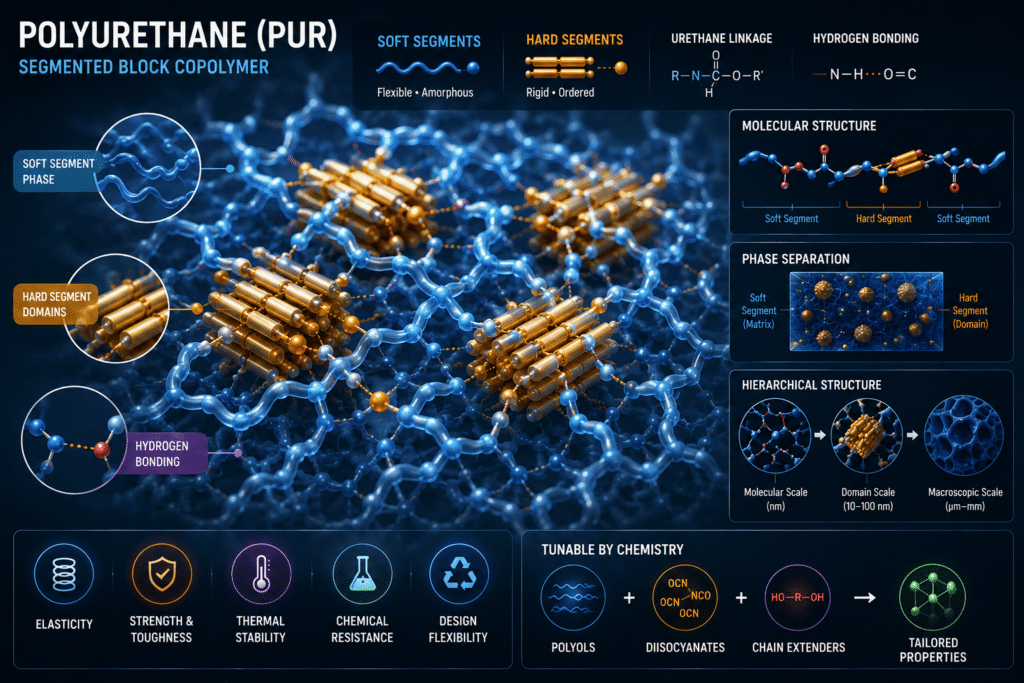
Visualization created with AI-based image generation.
Melting behavior and processing window
Segmented PUR systems typically have several characteristic transitions: one or two glass transitions and – in the case of crystalline soft or hard phases – specific melting areas. The melting temperature of the soft segments (e.g. PCL, PEO) is often in a range in which thermoplastic processing is possible, while highly cross-linked thermoset PUR systems no longer show a clear melting point, but decompose directly thermally (PMC NCBI, 2023).
Studies on PUR with variable soft-segment structure show that crystallizing polyols provide a clearly recognizable melt transition, the position of which depends on the molecular weight and chemical nature of the polyol. As the hard-segment concentration increases, the soft-segment crystallinity is weakened, the melting temperature decreases and the domains become more amorphous – which increases energy absorption under impact or shock loading (DOE OSTI, 2006). It is crucial for material development that the processing temperature window and heat resistance are largely determined by these melting processes: Thermoplastic PUR (TPU) utilize soft-segment melting for recyclability, while high-temperature stable coatings deliberately rely on cross-linked structures and suppress melting processes (ScienceDirect, 2021).
Material diversity: variants, copolymers and customized formulations
The molecular design freedom of PUR is based on the almost unlimited combination of diisocyanates, polyols and chain extenders. Polyether and polyester polyols, aliphatic or aromatic diisocyanates and functionalized chain extenders result in a range of materials from soft foams and rubber-like elastomers to hard, transparent materials (PMC NCBI, 2023). With a higher hard segment content (higher NCO index), Shore hardness, tensile modulus, tensile strength and tear strength increase, while elongation at break decreases. Conversely, a higher soft segment content or a longer polyol chain leads to greater elasticity and improved hydrolytic stability (Gantrade, 2021).
Recent work on water-based and bio-based PUR systems shows that UV stability, transparency and biocompatibility can also be specifically adjusted using suitable copolymer and additive concepts. For example, a water-based, transparent PU with an integrated benzotriazole UV absorber was developed that achieves tensile strengths of over 65 MPa and elongations of over 900% despite its high transparency (ACS Applied Materials & Interfaces, 2023).
Chemical, UV and mechanical resistance
The chemical resistance of PUR strongly depends on the soft segment chemistry: Polyester-based PUR offer higher solvent and abrasion resistance, but are more susceptible to hydrolysis. Polyether-based PURs, on the other hand, show better hydrolysis stability with lower abrasion and solvent resistance in some cases. Mechanically, the property profile can be very finely controlled via the hard segment content and the cross-linking density – from soft-elastic damping materials to high-strength coatings and fibers (DOE OSTI, 2006).
Conventional PUR is relatively susceptible to UV radiation: photochemical chain breaks and photo-oxidation lead to degradation of the mechanical properties and yellowing. Modern developments rely on built-in UV absorbers or antioxidant structural elements to significantly reduce this ageing. An intrinsically UV-stabilized, water-based PUR showed practically unchanged tensile strength and elongation at break after 24 hours of UV irradiation compared to the initial state (PMC NCBI, 2019). For outdoor applications or in aggressive media, the choice of PUR type and additives is therefore crucial for service life and reliability.
Thermal stability: limits and possibilities
The thermal stability of PUR is primarily determined by the chemical nature of the soft segments, the type of isocyanate and the cross-linking density. TGA studies show that the decomposition usually takes place in several stages: starting with the cleavage of the urethane bonds, followed by the degradation of the soft segments (PMC NCBI, 2023). Comparative studies of different polyether and polyester PUR show that the thermal stability varies only moderately despite different chain lengths – which underlines the suitability of polyester-based PUR for applications subject to higher temperatures.
In practice, this means that PUR foams for insulation or molded parts must be operated below the main decomposition temperature, but can achieve significantly improved thermal stability through suitable formulation – aromatic content, flame retardancy, degree of crosslinking. For demanding high-temperature applications, the combination of DSC and TGA is essential in order to precisely characterize glass transitions, melting events and the onset of decomposition (PMC NCBI, 2023).
Glass transition temperature: key to flexibility and application temperature
Depending on the segment structure, PUR can have one or more glass transitions: typically a Tg of the soft segments, which determines flexibility and low-temperature behavior, and possibly a Tg of the hard segments, which influences stiffness and heat resistance. The soft segment Tg for classic elastomer PUR is often between -50 °C and 0 °C, while hard segment glass transitions can be significantly higher (DOE OSTI, 2006).
The targeted adjustment of the soft segment Tg via the polyol chemistry is a key tool for controlling damping behavior, rebound resilience and low-temperature flexibility. Studies on segmented PUR fibers and elastomers show that crystalline soft segments broaden the effective Tg range and increase energy absorption below the melting point (Gantrade, 2021). For material characterization, the determination of Tg by means of DSC or dynamic mechanical analysis (DMA) is a key parameter which, in combination with TGA, provides a complete picture of the service limit (Tg), processing window (melting/softening) and end of life (degradation) (DOE OSTI, 2006).
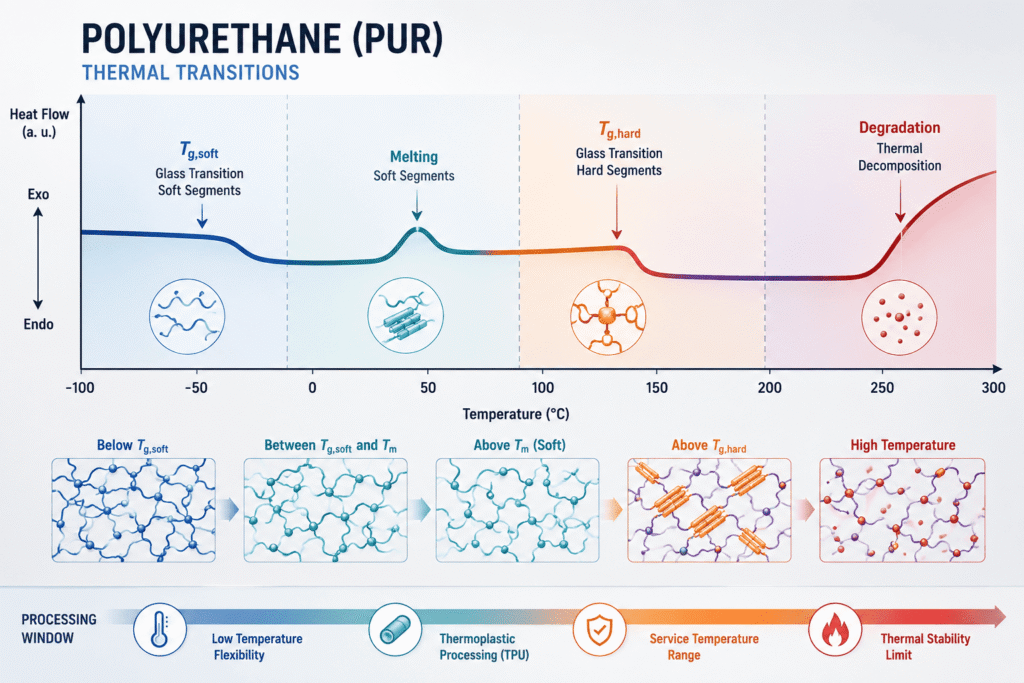
Visualization created with AI-based image generation.
PUR types at a glance
On a macroscopic level, the most important PUR classes can be characterized as follows (PMC NCBI, 2019):
Flexible PUR foam (e.g. mattresses, upholstered furniture, car seats): low density, low degree of cross-linking, dominant soft segment content, pronounced energy absorption.
Hard PUR foam (e.g. insulation boards, sandwich elements): higher cross-linking and hard segment content, better dimensional stability and compressive strength with low weight.
Thermoplastic polyurethanes (TPU): segmented block copolymers with phase-separated hard domains as physical cross-linking – melt-processable and recyclable.
Cast elastomers and coatings: often with a higher hard segment content and partial chemical cross-linking, high abrasion resistance and chemical resistance – used for rollers, wheels or protective coatings.
In addition, there are water-based PU dispersions for coatings, adhesives and textile finishes, in which functional groups and colloidal architecture represent additional levers for substrate adhesion, UV stability and barrier properties. Bio-based polyols and isocyanate-free systems extend this spectrum in the direction of sustainability (ACS Applied Materials & Interfaces, 2023).
Typical fields of application
PUR’s wide range of properties is directly reflected in its applications: foams are used in upholstered furniture, mattresses, car seats and insulation panels. Elastomers and TPU are used for rollers, conveyor belts, seals, shoe soles, flexible hoses and films. Coatings and adhesives protect metal, wood, concrete and textiles from corrosion and mechanical wear, and functional specialty applications range from medical components and flexible electronics to optically clear, UV-stable components (PMC NCBI, 2019; ACS Applied Materials & Interfaces, 2023).
The ability to formulate PUR both as a foam with a defined cell structure and as a solid, high-strength material makes it a universal construction and functional material in the automotive, construction, energy and medical technology sectors. The decisive factor here is always the correct selection of the PUR class and microstructure in relation to the subsequent mechanical, thermal and chemical load (Gantrade, 2021).
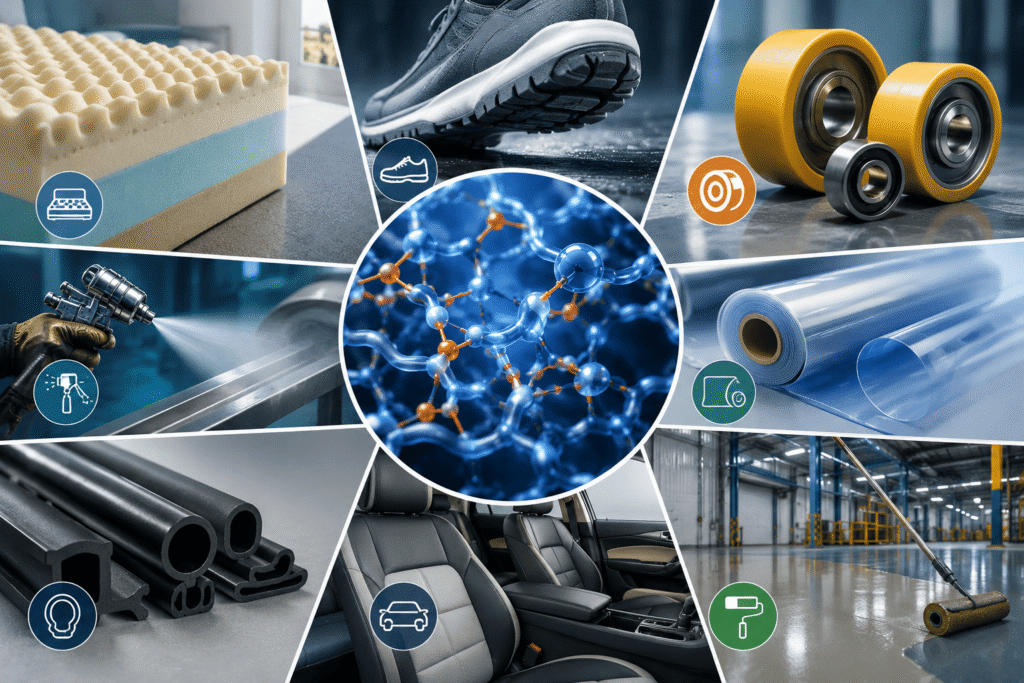
Visualization created with AI-based image generation.
Thermal analytical characterization with Linseis devices
For the development and quality assurance of PUR materials, thermoanalytical systems that record several parameters in one measurement run are particularly suitable. Simultaneous TGA-DSC devices from Linseis enable the simultaneous determination of mass changes and caloric effects and thus provide information on glass transitions, melting processes, crystallinity, reaction enthalpies and the onset of thermal decomposition – for PUR foams as well as for TPUs and coatings.
High-pressure and high-temperature STA systems also allow the investigation of ageing, oxidation stability and decomposition under different atmospheres and pressures, which is particularly relevant for PUR in energy and chemical engineering applications. The optional coupling with FTIR or MS enables a differentiated analysis of the volatile decomposition products and clarifies the mechanisms of thermal and thermo-oxidative degradation.
By combining these thermoanalytical methods with mechanical tests and spectroscopic techniques, a complete property profile is created – the basis for specifically positioning PUR between ultra-flexible and high-strength and precisely matching it to the requirements of modern applications.
Bibliography
Gantrade, 2021: Gantrade Corporation: Polyurethane Properties: Tailoring PUR Hard Block Segments. https://www.gantrade.com/blog/polyurethane-properties-tailoring-pur
DOE OSTI, 2006: U.S. DOE OSTI: Effect of the Degree of Soft and Hard Segment Ordering on Segmented Polyurethanes. https://www.osti.gov/biblio/914331
ScienceDirect, 2021: The Influence of Soft Segment Structure on the Properties of Polyurethanes. ScienceDirect/Construction and Building Materials. https://www.sciencedirect.com/science/article/abs/pii/S0950061821001483
PMC NCBI, 2023: MDPI Polymers: Polyurethanes: A Review of Synthesis, Properties, and Applications. PMC/NCBI. https://pmc.ncbi.nlm.nih.gov/articles/PMC10536526/
ACS Applied Materials & Interfaces, 2023: Colorless, Transparent, and High-Performance Polyurethanes with Intrinsic UV Resistance. ACS Publications. https://pubs.acs.org/doi/abs/10.1021/acsami.2c23317
PMC NCBI, 2019: MDPI Coatings: The Puncture and Water Resistance of Polyurethane Coatings. PMC/NCBI. https://pmc.ncbi.nlm.nih.gov/articles/PMC7022708/