


Customized Thermal Analysis for the Nuclear Industry

Linseis develops Simultaneous Thermal Analysis (STA) system with a robot-compatible lightweight furnace

Where standard measuring instruments reach their limits, our custom designs come into play: For a fully automated glovebox application in the nuclear sector, Linseis has developed a simultaneous thermobalance (STA) with a specially designed lightweight furnace—which, despite a weight limit of less than 5 kg, meets the high requirements for temperature homogeneity, heating and cooling rates, and measurement accuracy.


Dr.-Ing. Vincent Lisneis

Author: Dr.-Ing. Vincent Linseis

Bio: Managing Director and Head of R&D at Linseis Messgeräte GmbH

Alexandra Herrmann

Author: Alexandra Herrmann

Bio: Head of Marketing at Linseis Messgeräte GmbH

In the nuclear industry and high-security laboratory automation, strict requirements apply to measuring instruments: Radioactive or toxic samples are processed in isolated containment environments (glove boxes or hot cells), and direct human contact is avoided through the use of specialized robots and manipulators.
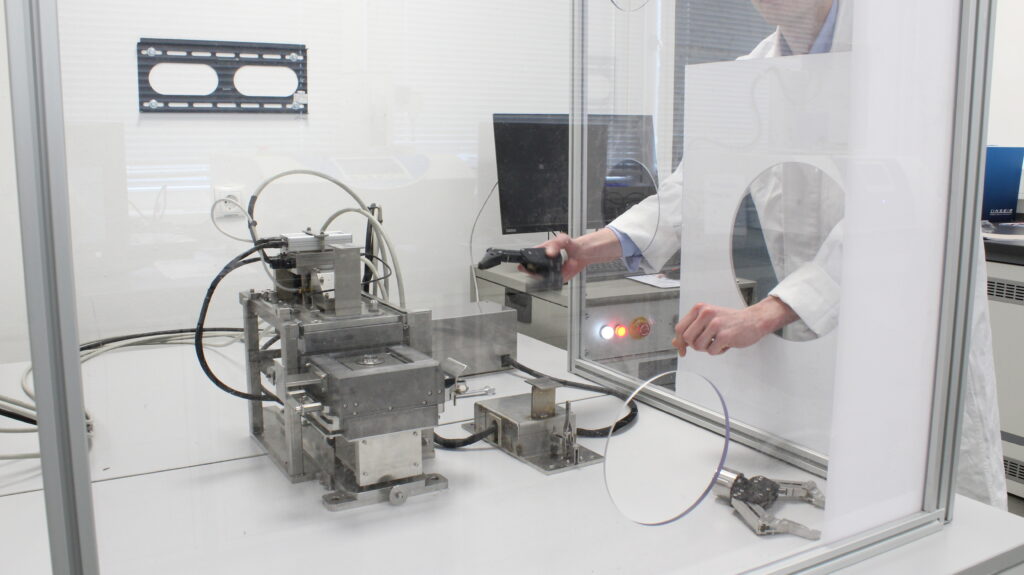
Sample photo of a measuring device in a glovebox

For a project in the field of nuclear robotics, the Linseis engineering team faced a unique design challenge: integrating a simultaneous thermal balance (STA) into a glovebox. Due to the robot’s maximum payload, the oven had to weigh less than 5 kg. At the same time, only a very limited installation space was available. While these design constraints can be resolved structurally, the real challenge lies in the thermodynamics of the system.

To meet this requirement, Linseis developed a custom-engineered solution. By using innovative insulation materials, a highly compact design, and a weight-optimized housing construction, the total weight of the oven was reduced to less than 5 kg—without compromising measurement accuracy, temperature resistance, or signal stability.

The real challenge: Thermal performance despite lightweight construction

When taking measurements in a thermal balance, the temperature quality inside the furnace directly determines the accuracy of the measurement results. A lightweight and compact furnace naturally has a lower thermal mass and less space for insulation materials. This makes it considerably more difficult to achieve high temperature uniformity, reproducible temperature control, and rapid temperature changes.

Transient temperature programs with high heating and cooling rates, in particular, generate strong thermal gradients that can affect the measurement results. However, these effects must be minimized to ensure precise measurements.

The goal of the development was therefore not merely to design the lightest possible stove, but to create a system that, despite the extreme operating conditions, offers the same thermal performance as significantly larger standard stoves.
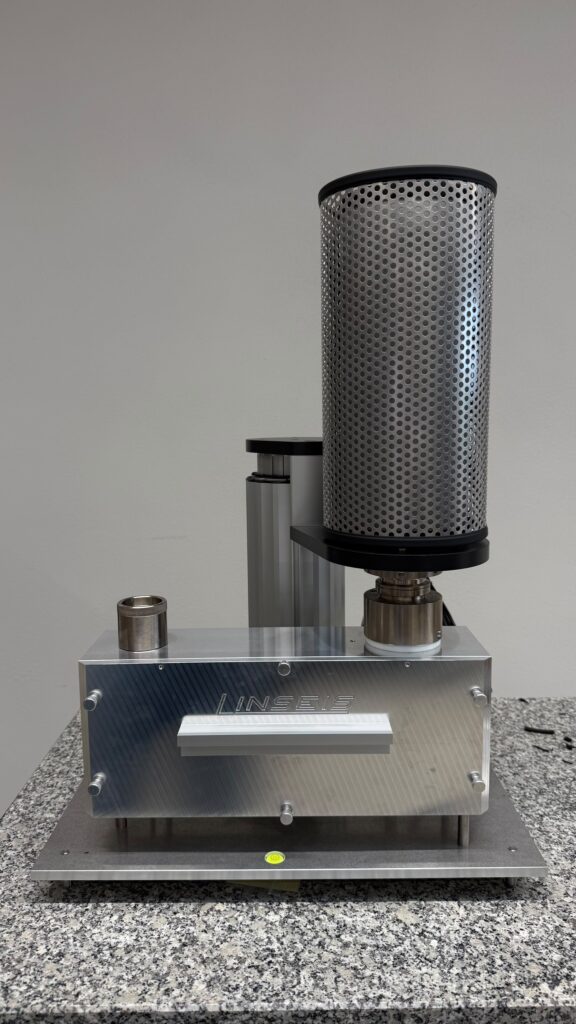
STA Simultaneous Thermal Analysis for Nuclear Research Using a Lightweight Furnace
Simultaneous thermal balance with a custom-configured light furnace capable of handling a maximum weight of 5 kg

General applications of a Nuclear STA

In addition to the project described, a nuclear STA covers a wide range of applications in research, operation, and decommissioning of nuclear facilities:

  • Safety and phase analyses of nuclear fuels: Investigation of the thermal behavior, phase transitions, and melting points of new or irradiated fuels (e.g., uranium/plutonium mixed oxides) as well as cladding materials under extreme temperature conditions.
  • Research on novel reactor materials: Testing the high-temperature resistance, oxidation, and thermal decomposition of special alloys, graphites, or ceramics, such as those used in Generation IV reactors or fusion concepts.
  • Conditioning and vitrification of radioactive waste: Thermoanalytical characterization of melting processes (e.g., borosilicate glasses or ceramic matrices) to permanently and stably encapsulate high-level radioactive waste for safe, long-term disposal.
  • Quality and safety control in decommissioning: Analysis of contaminated materials and samples from the decommissioning of nuclear facilities to determine their composition, outgassing behavior, and thermal stability prior to packaging.
  • Testing under defined toxic or radioactive inert gas atmospheres: Determination of decomposition and reaction kinetics in hermetically sealed environments where operating personnel must be protected from inhalation or radiation.

Engineering expertise for customized Thermal Analysis solutions

This project serves as a prime example of how innovative thermal analysis goes far beyond simply adapting existing systems. The key factor was not merely the development of a particularly lightweight furnace, but the successful combination of seemingly conflicting requirements: minimal dimensions and low weight, coupled with excellent temperature homogeneity, high heating and cooling rates, and the thermal stability required for precise STA measurements.

With such custom-designed solutions, Linseis expands the range of applications for thermoanalytical systems in areas where standard solutions reach their limits.

Did you like the article ?

Or do you have any questions? Feel free to contact us!

09287/880-53

Articles that you might also like