Crude oil consists of a broad mixture of heavy and light alkanes, alkenes, and aromatics.
Therefore, it generally needs to be refined, which means that the compounds are separated and purified, since they all have different uses—for example, as motor fuel, raw material for polymers, and in the chemical industry, among many others.
To verify the quality and composition of the raw material, a few rapid quality control tests are highly recommended. The DSC can be used to provide the desired information.
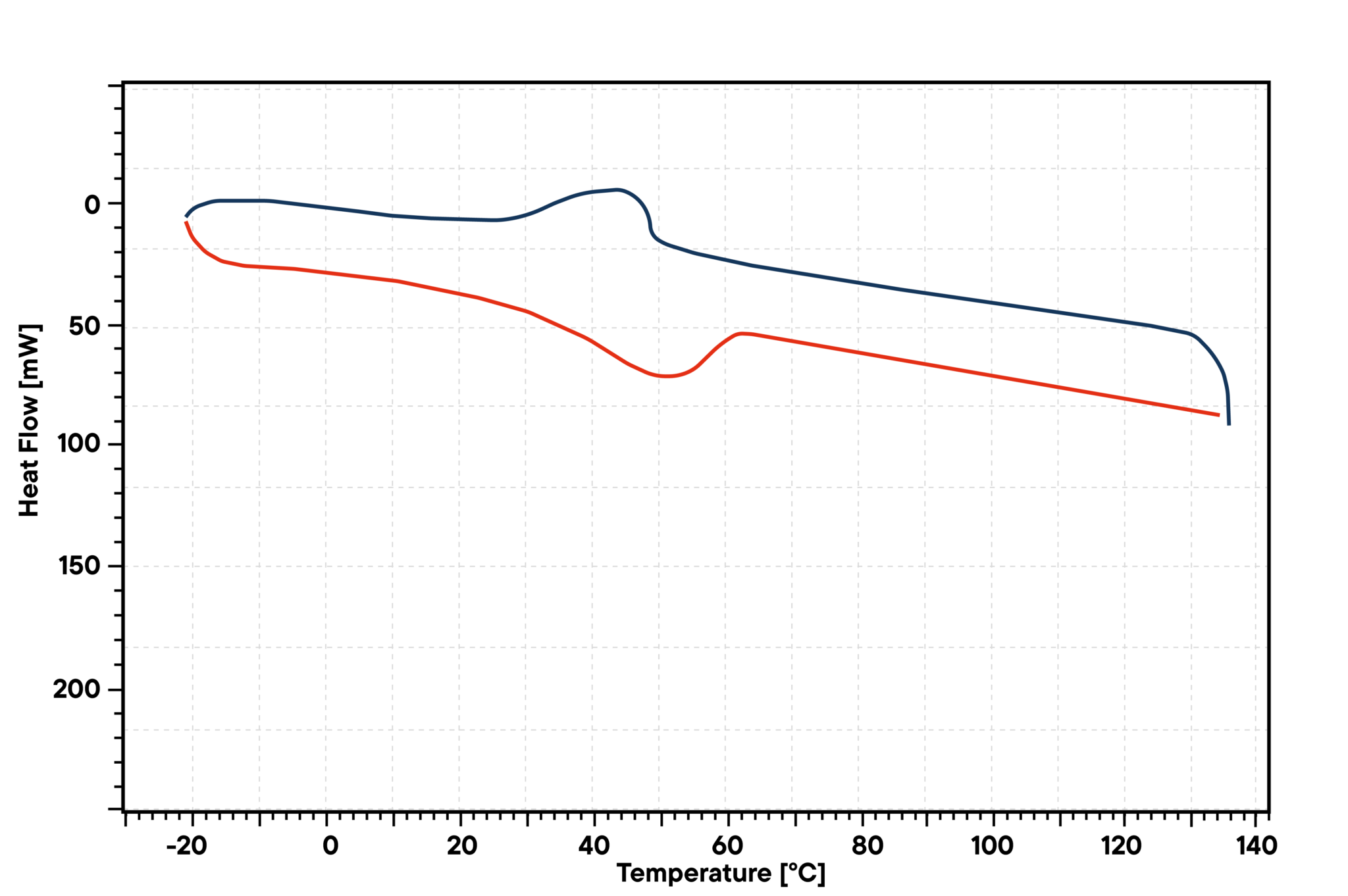
In addition to decomposition, there is a characteristic effect in the DSC diagram of crude oil that is of interest and can be used as a quality control parameter: the individual wax appearance temperature (WAT).
The graph shows the heating (red) and cooling (blue) curves for a crude oil sample between -20 °C and 140 °C.
When heated, the solid components become liquid, which leads to a decrease in the oil’s viscosity. These melting processes can be viewed as a broad peak, since many different compounds melt simultaneously over a certain temperature range.
During cooling, the exothermic effect may be crystallization can be observed as an exothermic effect. Since oils contain a certain proportion of heavy organic compounds that are not liquid at room temperature but are more or less solid, there is always a “wax content” in the oil.
When heated, these agglomerates melt in a broad peak that is difficult to interpret. However, upon cooling, the crystallization of these waxes begins in a well-defined and sharp manner, which can be observed at a specific temperature that can characterize the individual crude oil composition.