

Basic Research
Precise material characterization for new materials, fundamental material properties, and scientific questions


Basic research provides the understanding on which new materials, technologies, and industrial applications are built. Whether it’s novel ceramics, alloys, polymers, semiconductors, composite materials or functional materials—their targeted development requires a precise understanding of their fundamental physical and thermal properties.
Thermal and thermophysical analytical methods enable the study of phase transitions, reaction mechanisms, thermal expansion, heat capacity, thermal conductivity , and thermal stability. Temperature-dependent changes can be characterized under defined atmospheric conditions and across a wide range of temperatures.
LINSEIS’s flexible analytical instruments can be used to investigate a wide variety of scientific questions—from the initial characterization of a new material to the experimental validation of models and theoretical material concepts.
Relevant Questions
- What are the thermal properties of a new type of material?
- At what temperatures do phase transitions occur?
- What reaction mechanisms occur during heating or cooling?
- How does thermal conductivity change with temperature?
- What is the thermal expansion of the material?
- How stable is a material at high or low temperatures?
- How do atmosphere and temperature affect material behavior?
- What are the relationships between composition, structure, and material properties?
Relevant Material and Process Parameters
| Parameter | Meaning |
|---|---|
| Phase Transitions | Identification of Temperature-Dependent Structural and Phase Changes |
| Heat Capacity (Cp) | Fundamental Thermodynamic Material Behavior |
| Thermal Conductivity | Characterization of heat transport in the material |
| Thermal Conductivity | Rate at which heat propagates through a material |
| Coefficient of Thermal Expansion (CTE) | Temperature-dependent dimensional change of the material |
| Thermal Stability | Resistance to thermal stress |
| Mass Change | Analysis of decomposition, oxidation, and reaction processes |
| Reaction Enthalpy | Energetic Evaluation of Thermal and Chemical Processes |
Measurement Methods for Basic Research

Simultaneous Thermal Analysis (STA)
Simultaneous investigation of mass changes and thermal effects to elucidate complex material and reaction mechanisms.
Analysis of
- Phase Transitions
- Reaction enthalpies
- Bulk Changes
- Decomposition processes
- Oxidation and Reduction Reactions
Typical Applications
- Novel Materials
- Ceramics
- Metals and alloys
- Energy Materials
- Basic Research
Differential Scanning Calorimetry (DSC)
Precise characterization of thermal transitions and thermodynamic material properties.
Analysis of
- Melting processes
- Crystallization
- Glass transitions
- Phase Transitions
- Heat Capacity
Typical Applications
- Polymers
- Pharmaceutical materials
- Metals and alloys
- Functional Materials
- Materials Science

Laser Flash Analysis (LFA)
Determination of temperature-dependent heat transfer in a wide variety of materials.
Analysis of
- Thermal Conductivity
- Thermal conductivity
- Heat diffusion
- Temperature Dependence
- Thermophysical Properties
Typical Applications
- Ceramics
- Metals
- Semiconductors
- Composites
- Energy Materials

Dilatometry (DIL)
High-precision investigation of temperature-dependent dimensional changes and structural changes in materials.
Analysis of
- Thermal expansion
- Coefficient of Thermal Expansion
- Phase Transitions
- Shrinkage
- Sintering behavior
Typical Applications
- Ceramics
- Metals
- Glasses
- Powder Materials
- High-Temperature Materials
Recommended measuring instruments for basic research

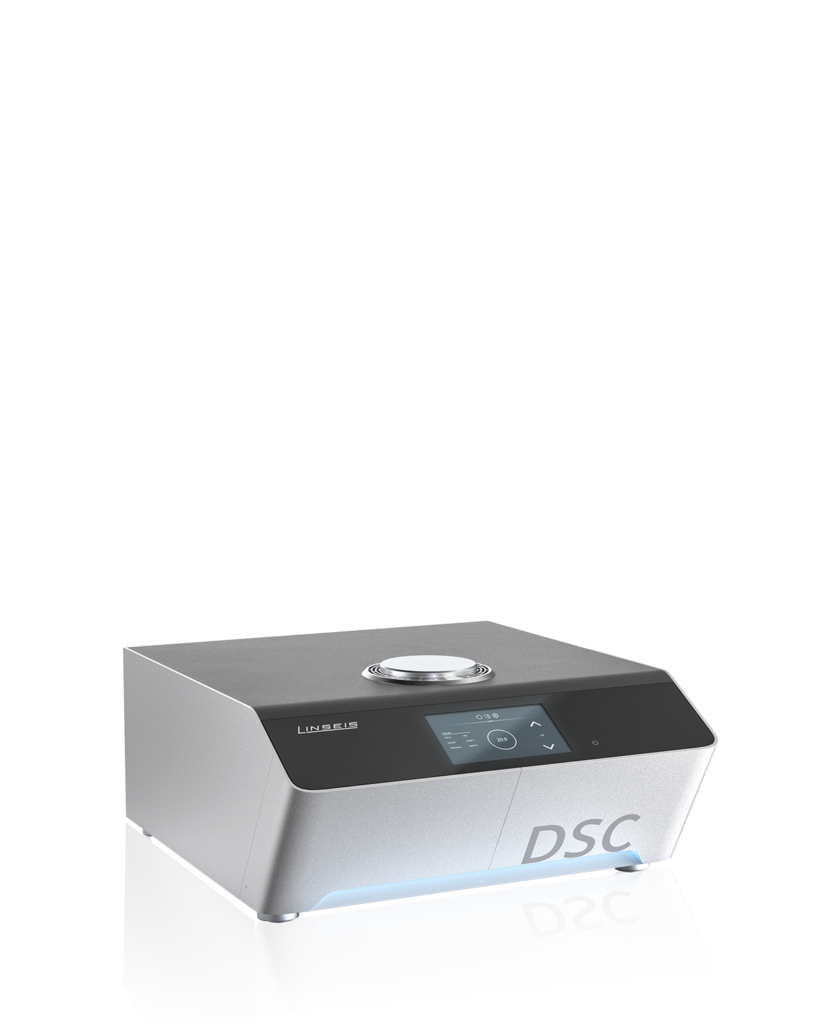
DSC L63

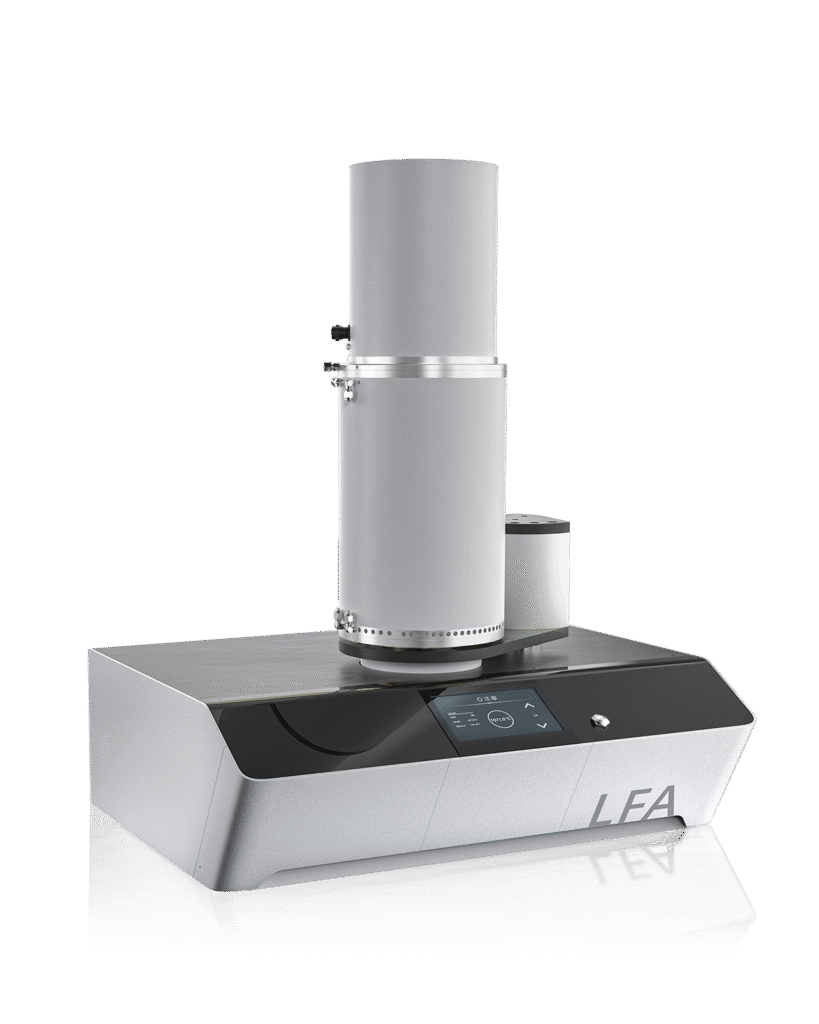
Case Study: Investigation of Fundamental Thermophysical Material Properties
Thermal Conductivity of SiC Raw Materials
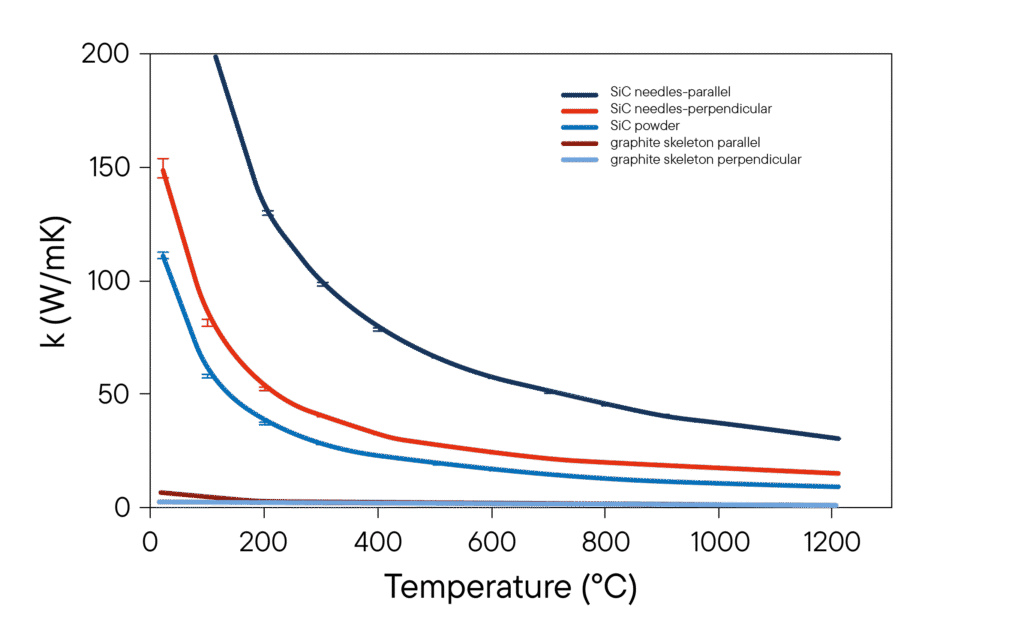
Laser-flash measurements using the LINSEIS LFA L52 demonstrate the influence of recrystallization, compaction, and material orientation on the thermal conductivity of SiC feedstock materials. The results highlight highly anisotropic heat transport behavior and provide important material data for modeling and optimizing PVT crystal growth of SiC. Download the white paper to learn more about the measurement setup, temperature-dependent thermal conductivity, and the interpretation of the measurement results.
Why Materials Characterization Is Crucial in Basic Research
Before a new material can be specifically optimized or qualified for a particular application, its fundamental properties and underlying mechanisms must be understood. Experimental material characterization provides the necessary data for this purpose.
The combination of modern analytical methods makes it possible to:
- Determination of Fundamental Thermal and Thermophysical Properties
- Identification of Phase Transitions
- Elucidation of Reaction and Decomposition Mechanisms
- Investigation of Temperature-Dependent Material Changes
- Characterization of Heat Transfer
- Analysis of Structure-Property Relationships
- Comparison of Different Material Compositions
- Validation of Theoretical Models and Simulations
Applications – Research & Higher Education
FAQ – Basic Research
What material properties can be studied in basic research?
Thermal and thermophysical analytical methods can be used to determine, among other things, heat capacity, thermal conductivity, temperature conductivity, thermal expansion, phase transitions, and thermal stability. This allows for the comprehensive characterization of materials and the investigation of fundamental structure-property relationships.
What materials can be analyzed using LINSEIS systems?
The portfolio is suitable for a very wide range of materials—including metals and alloys, ceramics, polymers, glasses, semiconductors, composites, powders, porous materials, and functional materials. This makes it possible to investigate novel materials for which no established characterization methods yet exist.
Which measurement methods are particularly well-suited for basic research?
STA, DSC, TGA, DIL, and LFA are among the key methods used in thermal material characterization. Depending on the scientific question being addressed, they can be supplemented by techniques such as GSA, TMA, and electrical and thermoelectric measurement methods.
Why is it beneficial to combine different measurement methods?
A single measurement method usually captures only part of a material’s behavior. By combining, for example, STA, LFA, and DIL, it is possible to correlate thermal reactions, heat transport, and dimensional changes and gain a more comprehensive understanding of material mechanisms.
Can measurements be taken under different atmospheric conditions?
Depending on the measurement system, experiments can be conducted in inert, oxidizing, reducing, or other defined gas atmospheres. This makes it possible to investigate how environmental conditions affect reactions, stability, and material properties.
Why are temperature-dependent material properties important for scientific models?
Many material parameters are not constant but vary—sometimes significantly—with temperature. Experimentally determined temperature-dependent data therefore enhance the accuracy of simulations and enable a more realistic description of material behavior.
How does thermal analysis support the development of entirely new materials?
It provides quantitative information on phase stability, reaction behavior, heat transfer, and dimensional changes even in the early stages of research. This makes it possible to identify promising material concepts and then further develop them in a targeted manner toward a specific application.