Heat-shrinkable materials soften at higher temperatures and thus conform to the shape of the object beneath them. This type of material is therefore suitable for sealing and protecting wiring harnesses, cables, pipes, and hoses.
Most cable insulation is made of various thermoplastic materials, which often contain silanes.
Yours, thermal conductivity is important due to its wide range of applications and should therefore be understood by users.
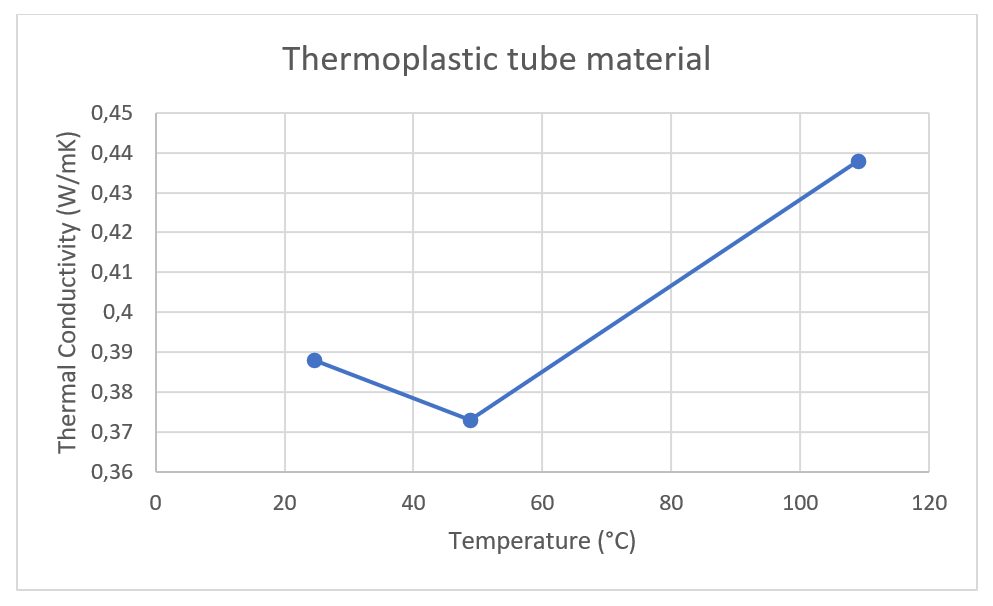
The sample tested was a compressed tubular material. Thermal conductivity was measured using the THB-100 (new models: THB Basic, Advance, Ultimate) at room temperature, 50 °C, and 110 °C.
To this end, the sample was placed in an oven together with the THB sensor (sandwich configuration). It was observed that the sample becomes softer at higher temperatures, whereas it is hard at room temperature—a typical behavior for this type of material.
The curve shows that the thermal conductivity initially decreases up to 50 °C and then rises rapidly up to 110 °C. This increase is likely amplified by the softening of the material, which significantly improves thermal contact with the sensor.