This test can compare the oxidation and degradation tendencies of materials and is therefore important for quality control and material selection.
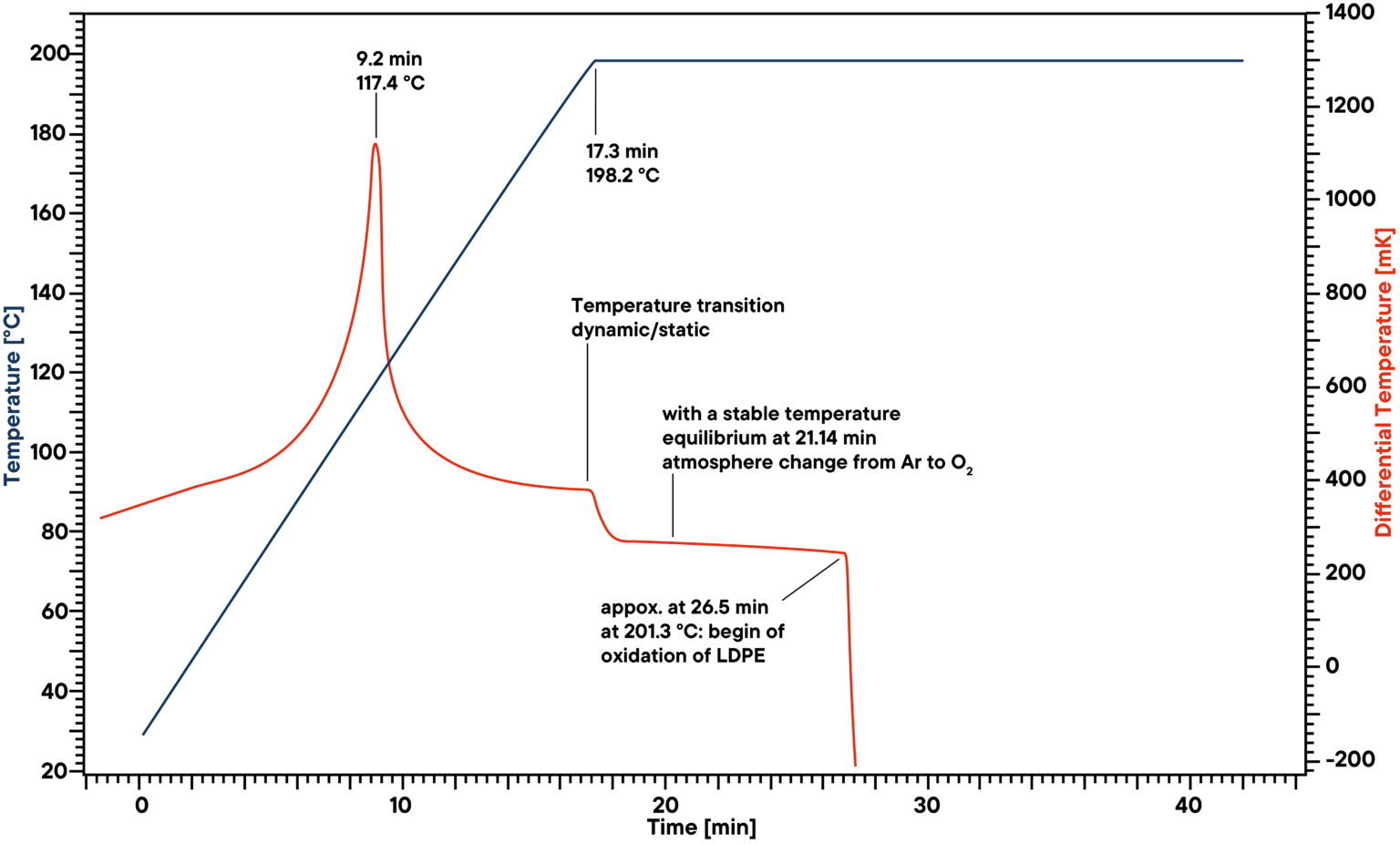
In this example, a small piece of low-density polyethylene (LDPE) was heated at a rate of 10 K/min with a constant argon flow rate of 10 l/h. At 200 °C, an isothermal segment was applied, and later the gas flow was switched from argon to oxygen at a rate of 10 l/h.
As soon as the heating ramp transitions into the isothermal segment, there is a “step response” in the heat flux signal. After the signal had stabilized again, the atmosphere was switched to oxygen. Seven minutes later, the heat flux shows a distinct change, indicating the start of oxidation.
The time delay between the switch to oxygen and the onset of the response signal is considered the oxidation induction time of the given material at 200 °C.
This information can be used to compare materials and predict their aging behavior.
Several national or international standards such as ASTM D3895, DIN EN 728, or ISO 11357-6 address this topic.