Chip-DSC 10 (Chip-DSC L66 Advanced) – Cp of a polymer – modulated Cp
To determine the specific heat , but not every method always yields correct results.
Whether or not a method can be used to determine Cp depends heavily on the type and form of the sample. DSC is generally a common technique for measuring the temperature-dependent Cp value, but it is sometimes not easy to perform.
This is particularly the case when the sample is not solid or undergoes phase changes within the measured temperature range.
With chip DSC, the Cp determination can be performed using just one crucible and a defined, temperature-modulated heating rate. Therefore, a calibration measurement is performed using a reference material (e.g., sapphire), followed by the measurement of the unknown sample, which can then be analyzed using this calibration.
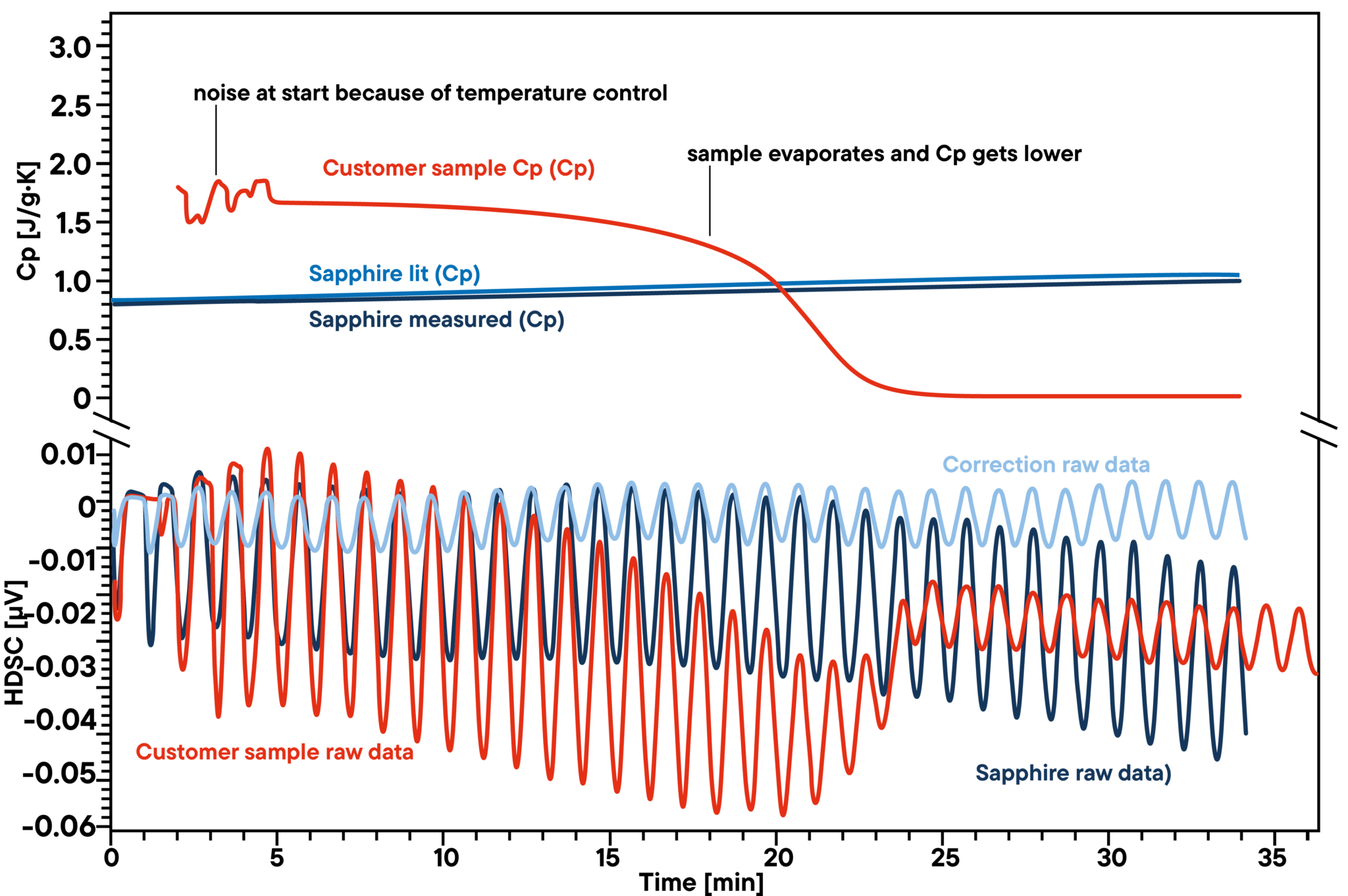
The measurement example shows the modulated measurement of the heat capacity of sapphire (green curve) at a heating rate of 10 K/min with an amplitude of 3 K. The upper curves show the evaluated resulting Cp, while the lower curves represent the modulated raw data curves. The Cp was determined with an error of 2% (yellow literature curve), which represents excellent measurement accuracy.
A calibration was created using the specified Saphir reference and applied to a polymer sample (red curve), for which a measurement was taken up to the point of decomposition and evaporation of the polymer.