Phase-change materials (PCMs), also known as latent heat storage devices, can store and release thermal energy during a phase change (e.g., solid to liquid).
During freezing, the material releases large amounts of energy in the form of latent heat of fusion, and during melting the material absorbs the same amount of energy from the environment. This allows PCMs to be used for heating or cooling.
The simplest example of a phase-change material is water/ice. Various paraffins and salt hydrates are also classified as PCMs.
In this study, sodium nitrate (NaNO₃) was examined over a temperature range from room temperature to 330 °C.
Thermal conductivity was measured using LFA, and the specific heat capacity was measured using DSC , and the density was measured using a dilatometer. Using these parameters, it was possible to determine the thermal conductivity .
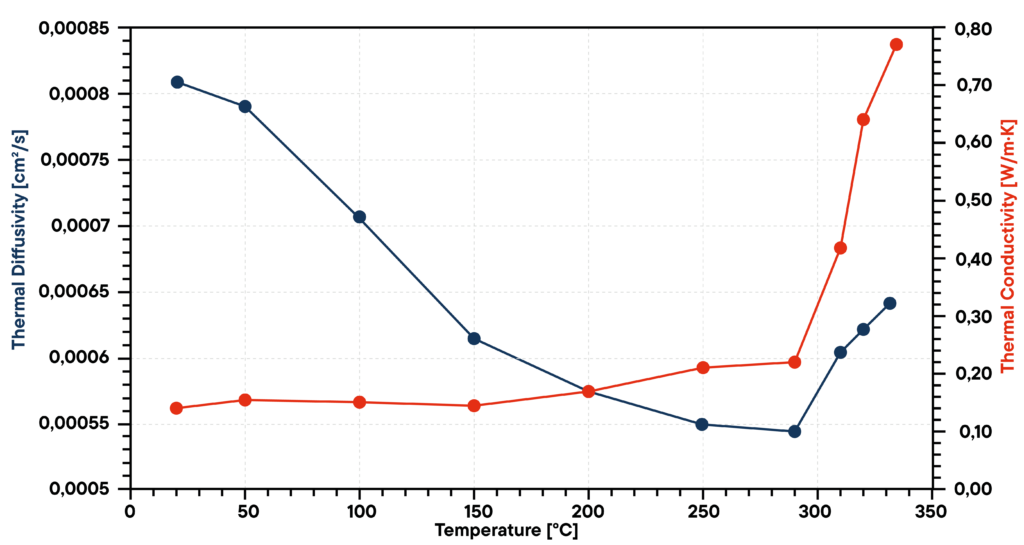
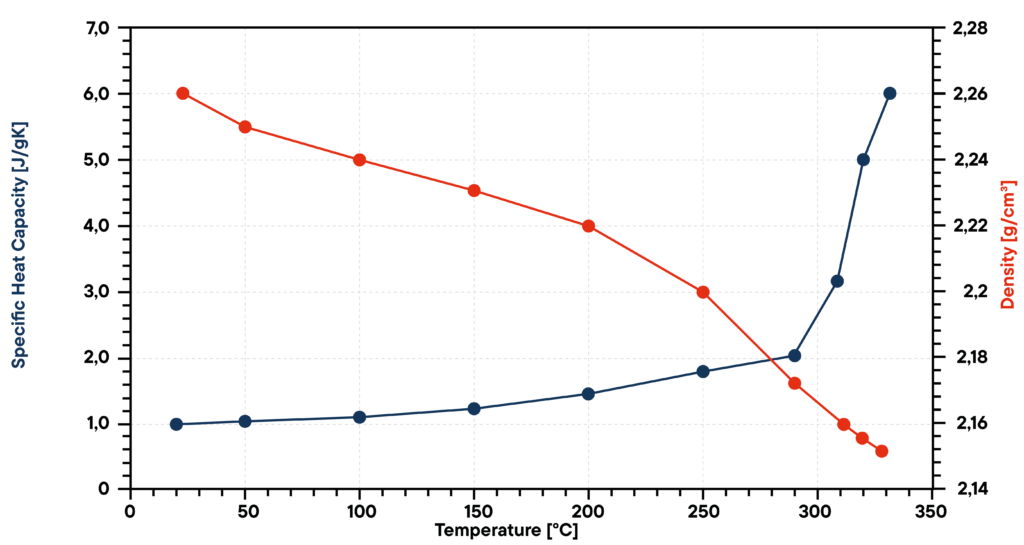
The phase transition from solid to liquid at a temperature of about 310 °C is visible in all diagrams.
The thermal conductivity of the solid decreases with temperature, and in the liquid state, it increases starting at 310 °C.
The specific heat capacity increases rapidly after the phase change. As the temperature rises, the density decreases.
Thermal conductivity behaves similarly to specific heat capacity; it increases slightly in the solid state and more rapidly in the liquid state.
Appropriate measuring device
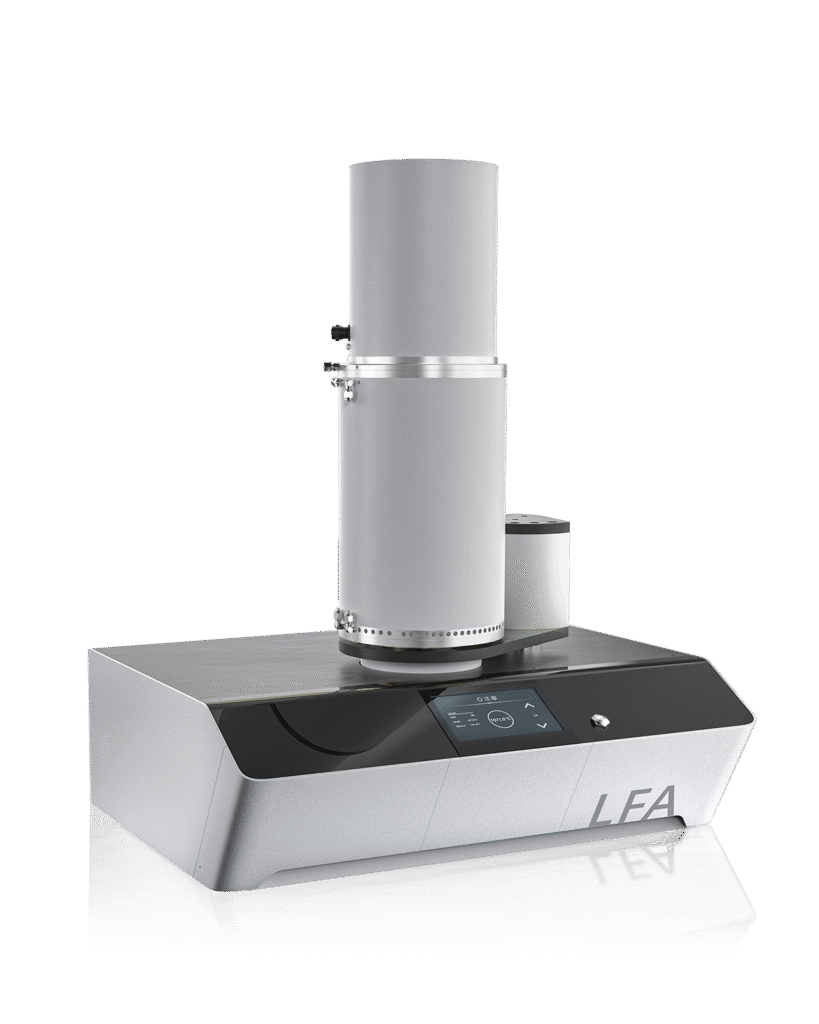
LFA L52
High-performance LaserFlash for measuring thermophysical properties