A gel is a colloidal system consisting of a continuous solid phase that encloses or permeates a liquid phase (often water). It behaves like a solid and is elastic, even though it consists largely of liquid. Gels are formed by the cross-linking of polymers or colloidal particles, which create a three-dimensional network that encloses the liquid.
Gels are classified as non-Newtonian fluids, which means that their flow properties do not follow the laws of classical Newtonian viscosity. Unlike Newtonian fluids, whose viscosity remains constant, non-Newtonian fluids such as gels respond differently to shear forces. Their viscosity can change under mechanical stress, such as pressure or stretching. As a result, gels exhibit viscous properties under slow deformation but tend to behave in a more solid or elastic manner under rapid or intense stress.
The cross-linking in the liquid phase gives it its macroscopically “solid” character. Gels come in various types and forms and are frequently used in pharmaceuticals or as adhesives.
A special type of gel is the so-called xerogel, from which the swelling agents are typically removed. Examples of xerogels include dried silica gel and gelatin.
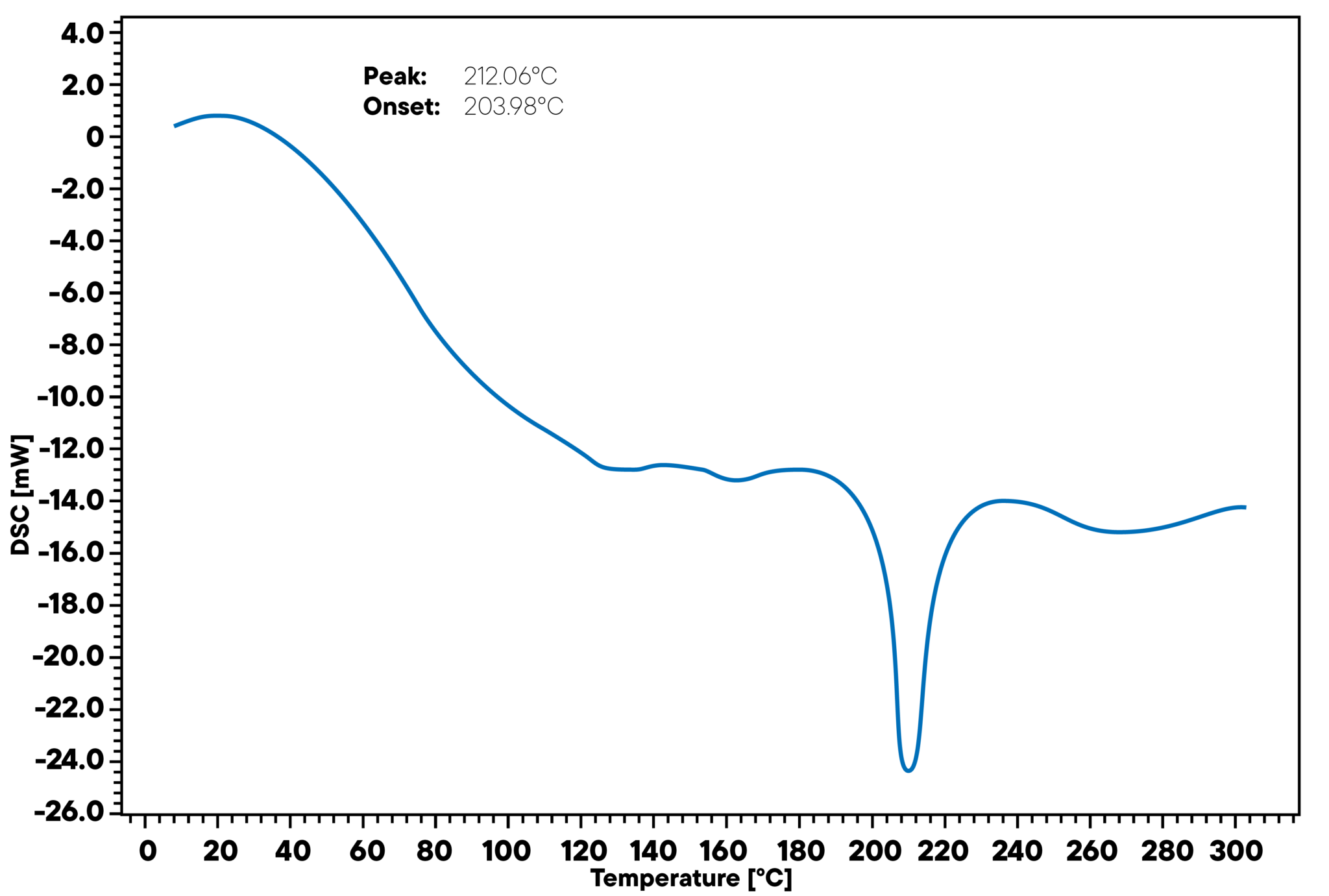
The curve shows a DSC scan of aluminum oxide nanoparticles in a gel matrix, heated at a linear heating rate of 10 K/min in a nitrogen atmosphere.
The signal shows two significant effects during the run that are worth examining more closely: In the range up to 120 °C, water loss occurs, which is due to the change in mass of the sample Cp change caused by thechange in massof the sample.
As a result of this effect, a dry gel matrix containing nanoparticles remains—known as a xerogel. At approximately 200 °C, a phase transition of the nanoparticles from an ordered to an amorphous aluminum oxide structure, which can be identified as a small, sharp peak.
These two effects are reproducible and provide a good characterization of the nanoparticle gel.