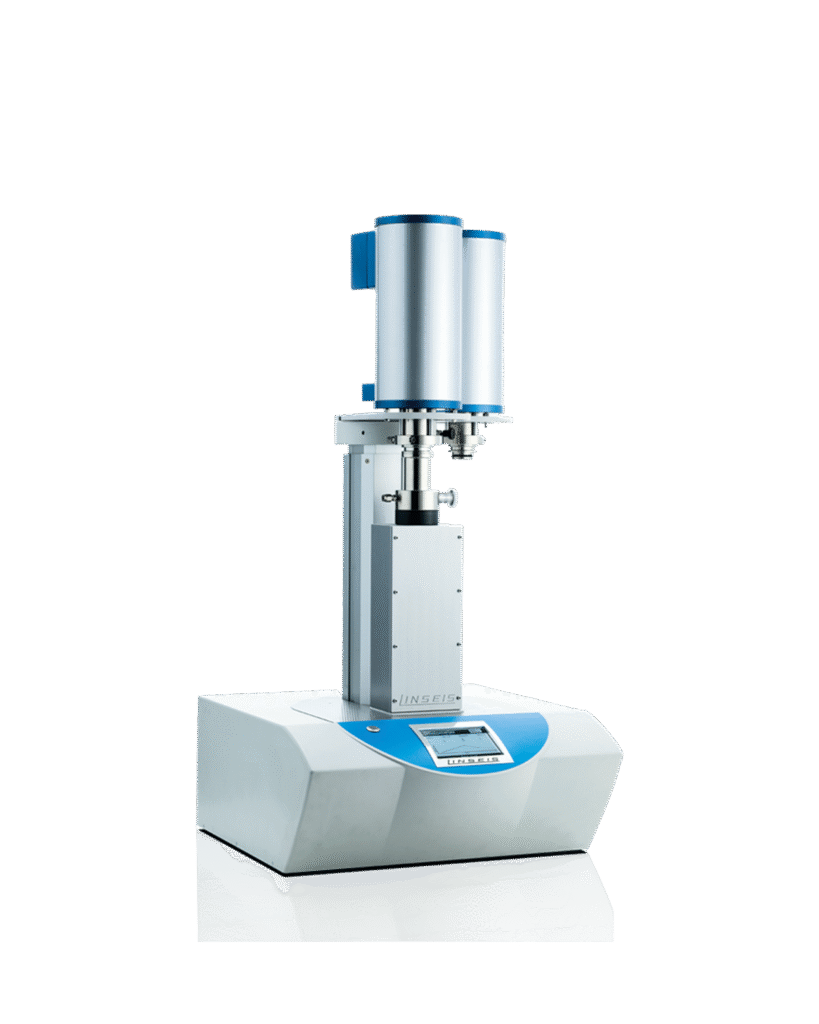
DIL L75 Vertical Single CRYO – Copper – Thermal Expansion
Thermal analysis involves not only measurements at high temperatures, but also experiments at very low temperatures. There are many fields in which measurements at low or even extremely low temperatures are of interest.
Of course, thermal expansion, phase transitions, and reactivity in this range must be known. For thermal expansion measurements, the Linzeis L 75 dilatometer series can be equipped with a closed-loop helium cryostat to enable measurements in the range of 10 K.
In this example, a copper standard was measured using a Linseis DIL L75 cryo-dilatometer from 10 K to 400 K (-260°C to 125 °C). To do this, the sample was placed in the measuring device, the sample chamber was evacuated, and the sample was then cooled to 10 K at a controlled cooling rate, followed by the expansion measurement shown here, with controlled heating at a rate of 5 K/min.
As the curve shows, there is a zone of nonlinear expansion between -260°C and -200°C, followed by linear expansion from -200°C to 125°C.