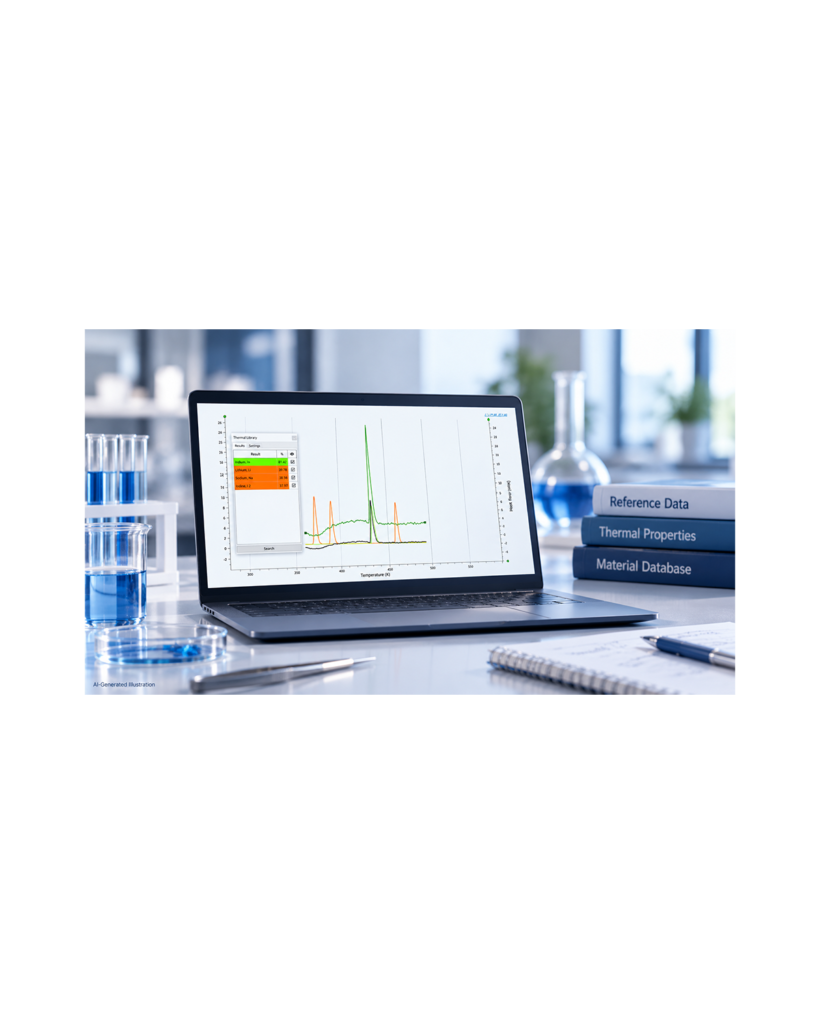
LINSEIS Thermal Library
Identify materials and compare measurement data – reconcile thermal properties with reference values and proprietary measurements within a common database.
Thermal and thermophysical measurements provide characteristic information about the behavior of materials. Melting temperatures, glass transitions, mass changes, or thermal transport properties can help characterize materials and identify differences between samples.
However, after evaluation, another question often arises: How can the determined properties be assigned to a material or compared with already known measurement results?
The LINSEIS Thermal Library extends the LiEAP Evaluation Software with a database-driven search and the comparison of thermal measurement data. Evaluated properties from a measurement can be matched against existing reference data as well as your own saved measurements.
At the same time, the database can be expanded with additional materials and reference measurements. With increasing use, this creates an individual knowledge base that can be used for future material investigations.
From Measurement to Material Comparison
In many laboratories, similar materials are examined on a regular basis. The resulting measurement data contain valuable information, but are often stored within individual projects.
If a new sample is to be compared with earlier investigations, the relevant measurements must first be found again and their results compared.
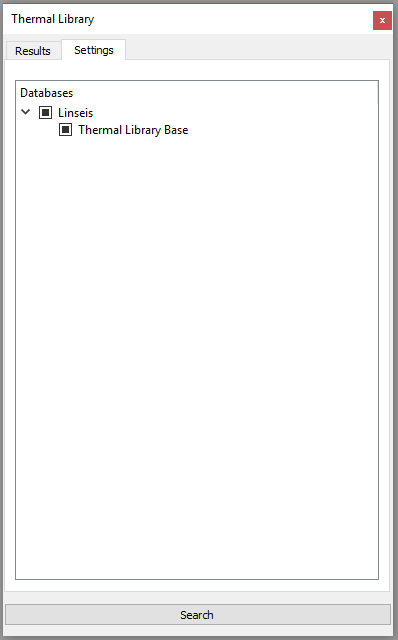
The Thermal Library supports this step by consolidating evaluated material properties in a searchable database.
In addition to existing reference and literature values, your own measurement results can be stored and used for later comparisons. This allows already characterized materials to be specifically used as a reference for new investigations.
How does the LINSEIS Thermal Library work?
The basic process comprises five steps:
Measurement → Evaluation → Feature selection → Database search → Comparison
Perform and evaluate the measurement
First, the sample is examined using the appropriate LINSEIS measurement system. The recorded measurement data are then opened and evaluated in the LiEAP Evaluation Software.
Which properties are determined depends on the measurement method used.
With a DSC measurement, for example, characteristic peak temperatures, melting enthalpies, or glass transitions can be determined. In thermogravimetric analysis, by contrast, mass changes and the associated temperature ranges are the primary focus.
These evaluation results form the basis for the subsequent database search.
Select relevant material properties
After evaluation, the properties to be used for comparison with existing materials are defined. With a TGA measurement, for example, a relative mass change and the temperature of the corresponding event can be selected.
For DSC measurements, peak temperatures, melting temperatures, or peak areas, among others, are available as comparison features.
The selection depends on the specific question. Not every thermal event is equally suitable for distinguishing a material.
By selectively combining several features, the search can be focused on those properties that are relevant for the current investigation.
Consider measurement conditions
Thermal measurement results do not depend solely on the material under investigation. The experimental conditions can also influence the course of a measurement curve and the characteristic values determined.
These include, for example, the heating rate, the gas atmosphere, or other method-specific measurement parameters.
The Thermal Library makes it possible to take such conditions into account as filters in the database search.
This is particularly relevant when results from different measurements are compared with one another. For example, data sets generated under similar experimental conditions can be prioritized.
A meaningful material comparison nevertheless requires that the selected characteristic values and measurement conditions are technically compatible.
Search the database for suitable materials
After selecting the features, the database search is started.
The Thermal Library matches the selected properties against existing data sets. Both provided reference data and your own saved measurements can be taken into account.
For example, the database can contain reference information on different raw materials, material grades, production batches, or internal standards.
The comparison is therefore not limited to generally available material data, but can also draw on existing knowledge from your own laboratory.
Evaluate and compare search results
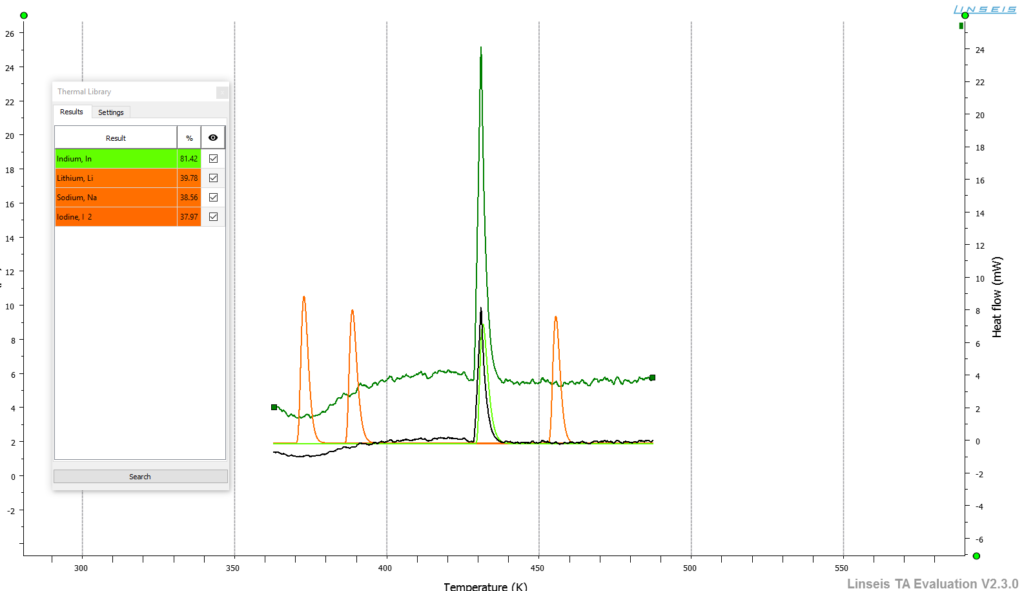
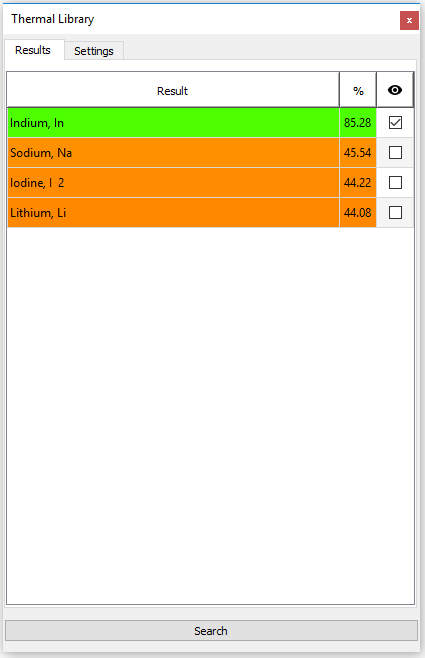
The results of the database search are displayed in an overview.
For each found data set, the Thermal Library shows a percentage match value. This describes how well the selected properties of the current measurement match the respective database entry.
In this way, several potentially suitable reference materials can be compared.
The search typically takes one to two seconds.
Important for interpretation: A high percentage match does not automatically mean that a material has been uniquely identified. The value initially describes the agreement of the considered features. For a reliable material assignment, the measurement conditions, the significance of the selected properties, and possibly further investigation results must also be taken into account.
Material Identification with DSC, TGA, and STA
Which material properties are used for the database search depends on the measurement method. The principle can be explained particularly clearly using differential scanning calorimetry and thermogravimetric analysis.
DSC: Thermal transitions as characteristic features
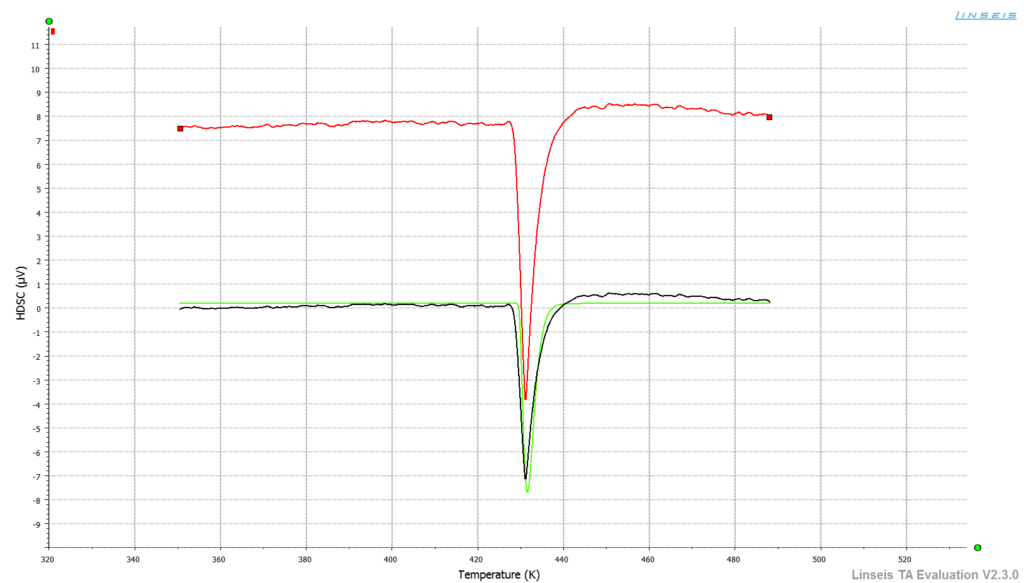
The differential scanning calorimetry (DSC) is used to investigate thermal transitions and reactions. These include, for example, melting and crystallization processes as well as glass transitions.
Under defined experimental conditions, many materials exhibit characteristic thermal events. The temperatures and enthalpies determined from these can provide important indications of material composition and material state.
In the Thermal Library, the corresponding evaluation results can be used as features for comparison with existing reference data.
For a polymer sample, for example, determined melting temperatures can be compared with stored reference materials. If several characteristic properties match, this can help narrow down potential materials.
However, different polymers can exhibit similar thermal transitions. Crystallinity, additives, and thermal history also influence the measurement result. Therefore, the assignment should not be based solely on a single peak temperature.
TGA: Using Mass Changes for Material Comparison
In thermogravimetric analysis (TGA) the mass of a sample is continuously recorded during a defined temperature program.
Evaporation, decomposition, or chemical reactions can lead to characteristic mass changes.
In addition to the magnitude of the mass loss, the temperatures and temperature ranges in which a mass change occurs can provide important information.
The Thermal Library makes it possible to use these properties for comparison with existing material data.
A typical application example is the investigation of plastics with different filler contents. Here, characteristic decomposition ranges and the remaining residual mass can indicate differences between the samples.
In particular, the gas atmosphere and the heating rate must be taken into account, as they can influence thermogravimetric behavior.
STA: Considering multiple measurement signals together
Simultaneous thermal analysis (STA) combines thermogravimetric and calorimetric measurement information within a single experiment.
This provides both mass-change data and information on thermal events.
In a material investigation, for example, a characteristic mass loss and a simultaneously occurring thermal event can be considered together.
Combining different measurement information can help characterize materials more precisely than using a single measurement signal.
Build Your Own Reference Database
In addition to comparing with existing reference data, the Thermal Library allows you to build your own material database.
New measurements can be recorded and used as a reference for later investigations.
In this way, the material knowledge acquired in the laboratory can be gradually expanded.
Targeted Comparison of Recurring Materials
Especially for regularly investigated materials, a proprietary reference database can facilitate the comparison of new samples.
In quality control, for example, measurement data of approved raw materials can be stored as a comparison basis. New material batches can then be reconciled with these references based on selected thermal properties.
A structured collection of proprietary measurements can also be helpful in research and development.
If different material formulations or development stages are investigated, their characteristic properties can be stored and later used again for comparative studies.
This creates a database that not only documents individual measurement results but also supports the development and evaluation of materials.
Reference Measurements under Comparable Conditions
For a meaningful comparison, reference and sample measurements should be carried out under conditions that are as comparable as possible.
Different heating rates, atmospheres, or sample preparations can lead to deviating results, even if it is the same material.
Therefore, relevant experimental parameters should be considered together with the evaluated material properties.
The ability to include such measurement conditions in the database search supports a more targeted selection of suitable reference measurements.
Visualization created with AI-based image generation.
Thermal Library and LiEAP: Share Measurement Data
The Thermal Library is integrated into the LINSEIS LiEAP software concept as an optional extension.
While LiEAP supports the preparation, execution, and evaluation of measurements, the Thermal Library complements the workflow with the database-driven comparison of material properties already determined.
Evaluated measurement data can therefore be viewed not only within a project, but also linked with existing reference information.
This enables a continuous workflow from measurement to material assessment:
Measurement preparation → Data acquisition → Evaluation → Database comparison → Documentation
For laboratories that regularly examine similar materials, this can create a structured link between current measurement results and existing material knowledge.
Learn more about measurement preparation, data acquisition, and evaluation with LINSEIS LiEAP.
Utilize Measurement Data as Material Knowledge Long-Term
The LINSEIS Thermal Library complements classic measurement data evaluation with the option of systematically comparing characteristic material properties with existing references.
By combining database search, consideration of relevant measurement conditions, and storage of your own reference measurements, measurement results can be used beyond individual investigations.
This creates a growing material database that supports the comparison of new samples and makes existing knowledge accessible for future research and testing tasks.