Typical alloying elements in aluminum include copper, manganese, magnesium, tin, zinc, and silicon. Depending on the manufacturing process, aluminum alloys can be classified as cast alloys or wrought alloys, both of which are further subdivided into heat-treatable and non-heat-treatable alloys.
The alloying process alters the material’s mechanical and thermal properties, such as density, melting point, hardness, and tensile strength. Alloys are used in mechanical engineering, automotive manufacturing, aerospace, and the metal industry in general.
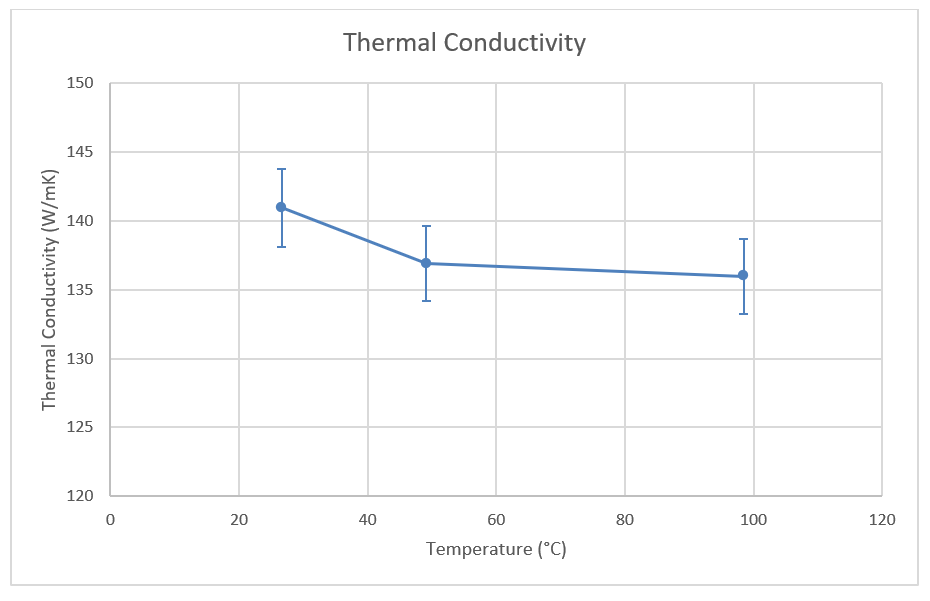
The thermal conductivity of an aluminum alloy was measured using the THB from room temperature to 100 °C.
For the measurement, the QSS sensor was placed between two sample pieces, which were pressed together to improve thermal contact. The setup was placed in an oven.
The temperature steps were room temperature, 50 °C, and 100 °C. For each step, the measurement was repeated three times, and the results were averaged.
The graph shows that the thermal conductivity decreases slightly with temperature. The error bars indicate an uncertainty of ±2%.