DIL L75 Vertical Single – Iron – Thermal Expansion
Iron is one of the most commonly used building materials and one of the most abundant metals in the world.
All steels consist mainly of iron, which means that most vehicles and buildings are made up of iron to a greater or lesser extent.
The mechanical properties of iron make it an ideal material for all of these purposes. It is very hard, strong, easy to work with, and can be forged over an open fire.
Most steels contain various other metals and carbon in different amounts, which give them many properties such as color, hardness, chemical resistance, and much more.
Of course, iron is one of the best-known materials, and the analysis of iron and steel is one of the most common applications in thermal analysis.
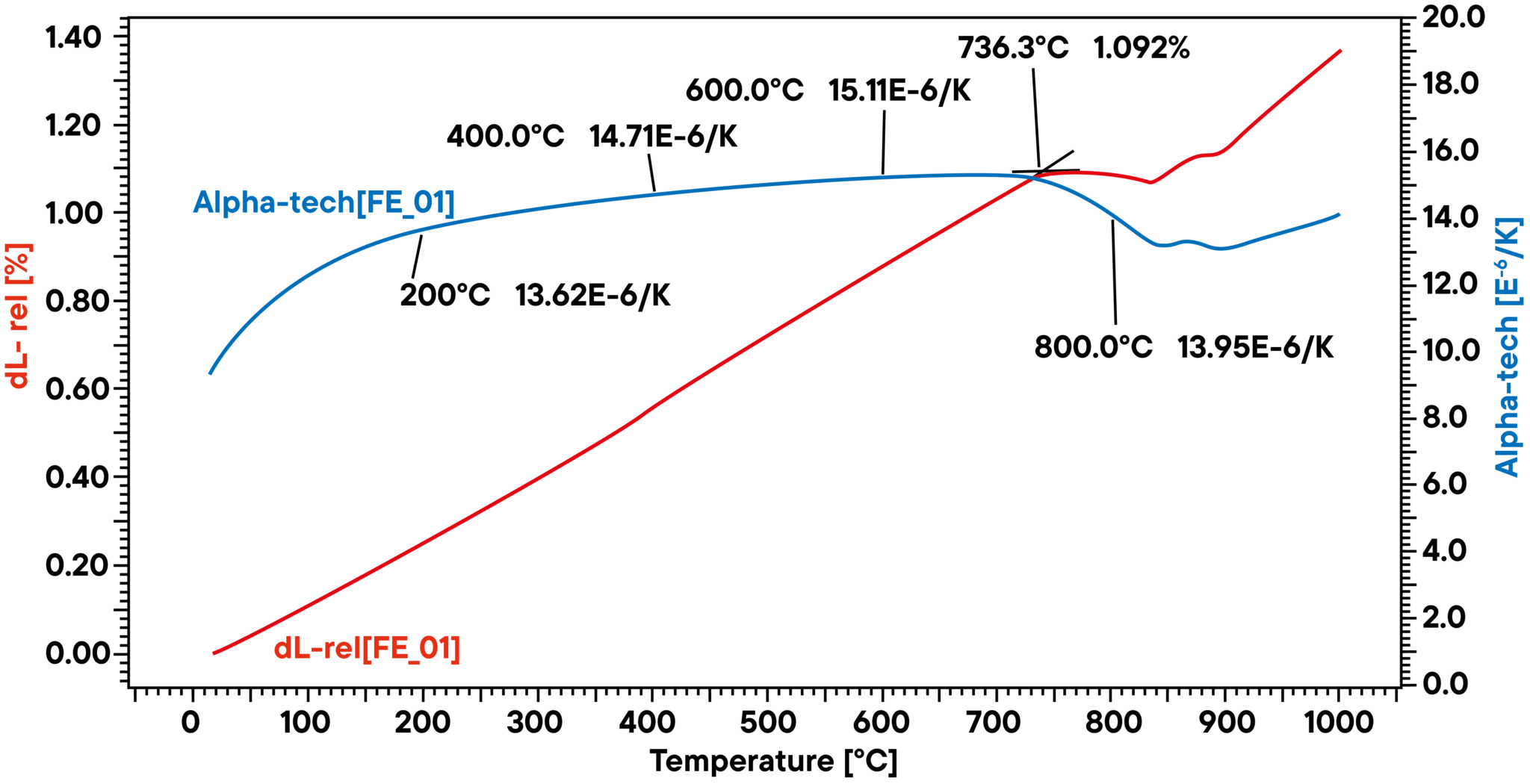
This measurement illustrates the linear thermal expansion (relative ΔL – red curve) and the coefficient of thermal expansion (CTE) (blue curve) of the iron sample in an argon atmosphere.
The heating rate was 5 K/min. Above 736.3 °C (the maximum value of the coefficient of thermal expansion), shrinkage is observed, which is attributable to a phase transition effect also known as the Curie point.
The difference between the measured value and the value reported in the literature can be attributed to impurities in the sample and minute traces of other elements that were present.