Polyethylene (PE) is the most commonly used polymer because it is easy to manufacture and offers many possibilities. Thanks to its low weight, good electrical insulation properties, and excellent chemical resistance, it has thousands of applications, particularly in packaging, films, bottles, and much more.
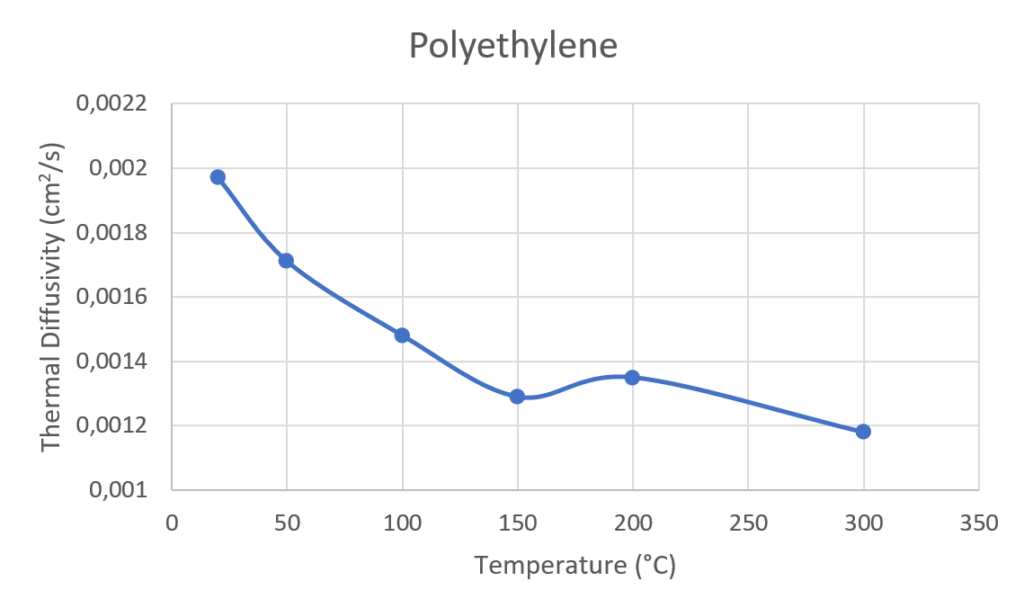
The diagram above shows the LFA measurement of the thermal conductivity of a 1 mm-thick PE sample. For the measurement, the sample was placed in a liquid sample holder with a sealed bottom and lid.
To improve heat transfer between the sample and the sample holder, both sides of the sample were coated in the center with a very thin layer of zirconium dioxide coating paste.
This allows the sample to absorb the energy directly with minimal loss. The measurement was then performed in a helium atmosphere at temperatures up to 300 °C.
Up to the melting point (between 130 °C and 145 °C), thermal conductivity decreases.
Once the sample has melted, its thermal conductivity increases slightly, and at 200 °C, the sample begins to decompose, as indicated by a decrease in thermal conductivity.
Appropriate measuring device
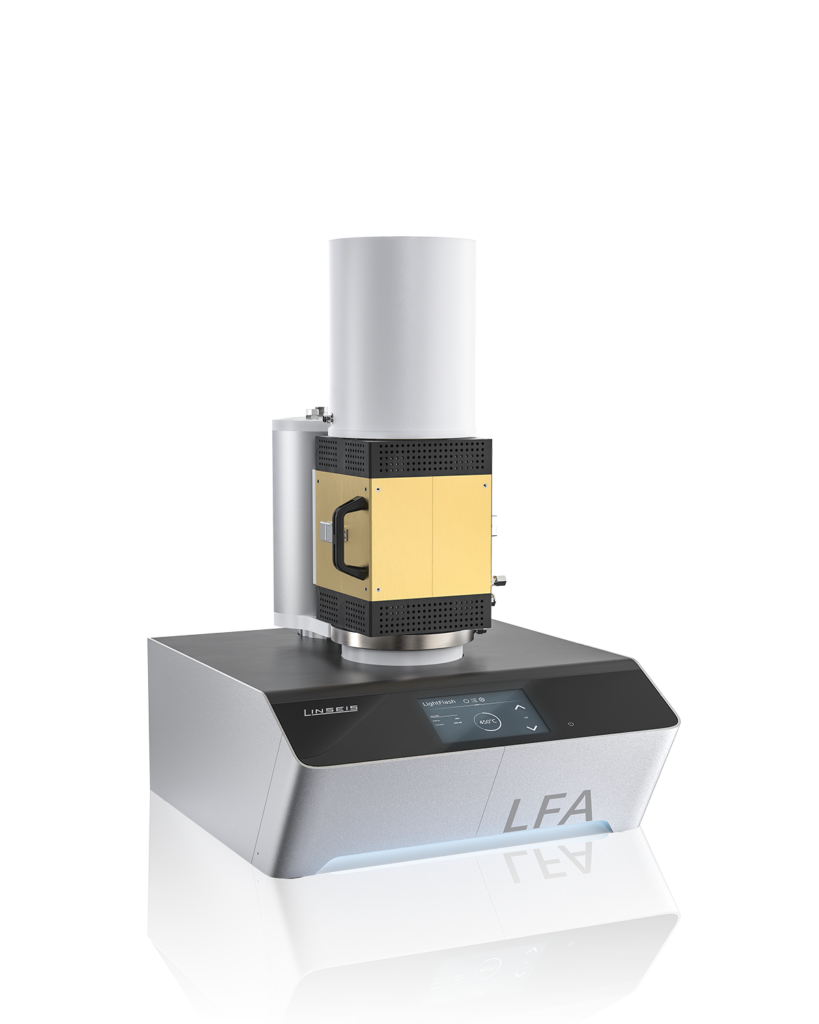
LFA L51
Simple and cost-effective measurement of thermal conductivity