Carbon-containing materials, organic substances, and polymers generally burn when heated.
The analysis of the thermal decomposition of such materials is therefore somewhat specialized. In most cases, it is carried out in inert atmospheres rather than in air in order to observe decomposition effects and pyrolysis, followed by a change in gas to oxygen or air, which leads to the combustion of the carbon contained in the material.
If this process is performed using a combined thermogravimetric analyzer and DSC (STA), the carbon content, the inorganic fraction, and the heat released can be measured.
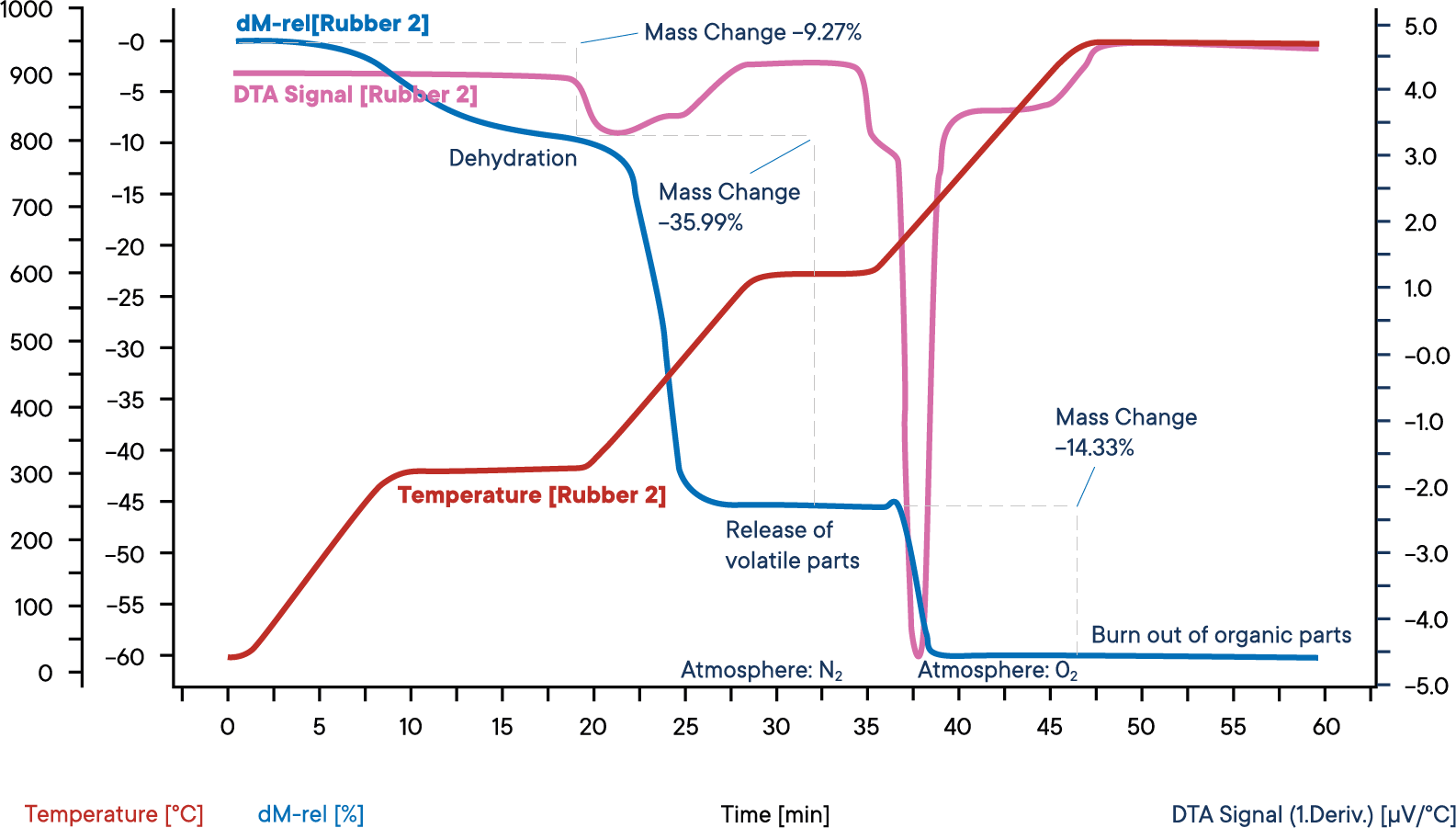
This measurement of an industrial rubber sample was performed using an STA L81, starting in a nitrogen atmosphere. The sample was heated in three steps, each at a rate of 30 K/min.
The blue curve shows the relative weight loss. During the initial weight loss stage, the sample undergoes dehydration. The water content was 9.3%. The corresponding DTA signal (purple curve) showed no change during the evaporation of the water.
In the second reaction step, the volatile components are released by pyrolysis in a N2 atmosphere. These components account for 36.0% of the total. Their release is indicated by an exothermic reaction peak on the DTA curve.
For the third reaction step, the atmosphere is switched to oxygen, which causes the remaining carbon to burn.
The weight loss is 14.3%. The remaining 40.4% consists of inorganic components such as ash, slag, or fillers.
Appropriate measuring device
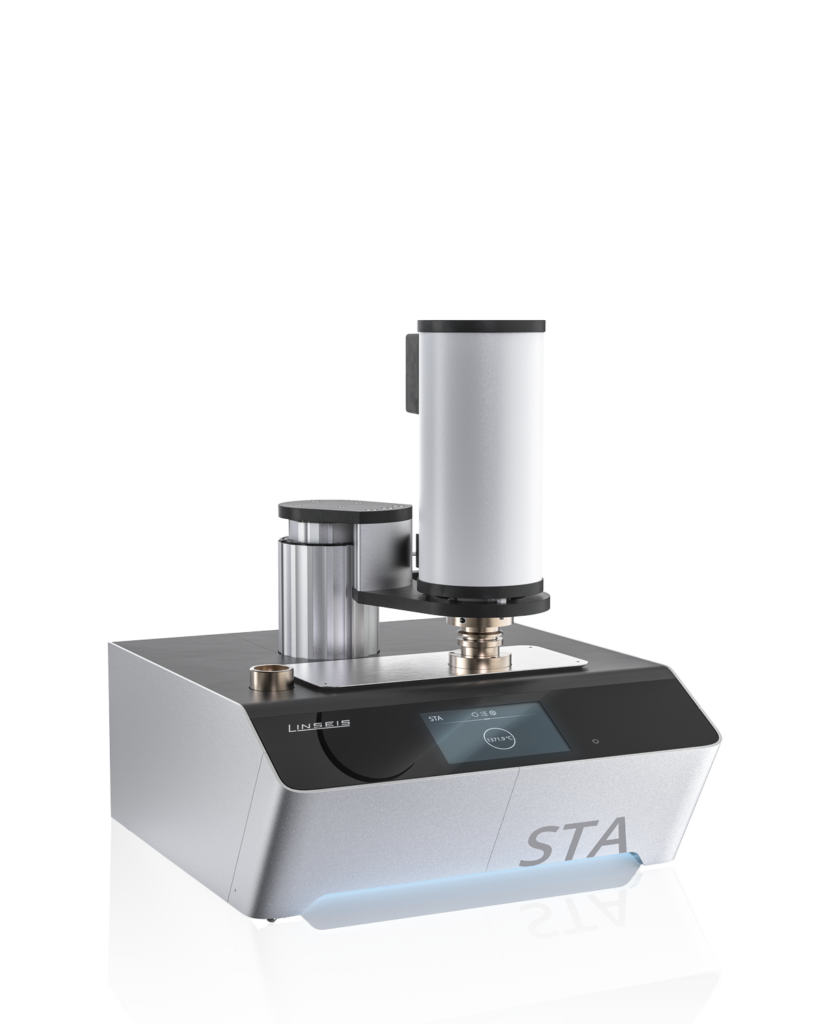
STA L81
TG + DSC – High temperature STA with furnace configuration up to 2400°C