LFA L52 – Glass – Thermal Conductivity / Temperature Conductivity / Specific Heat Capacity
Glass generally has many uses, such as in everyday life (tableware), architecture (windows), art, optics, laboratories, packaging, and more.
Since every application has different optical, mechanical, and thermal requirements, and since different compositions and manufacturing processes can influence these properties, it is therefore essential to investigate various types of glass.
The sample under investigation is an optical glass with a low glass transition temperature (Tg: 496 °C) and softening point (TS: 558 °C).
The thermal conductivity should be investigated in the temperature range between room temperature and 600 °C. To this end, thermal conductivity was determined using the LFA L52, and specific heat capacity was determined using a DSC. Thermal conductivity can be calculated using the specified density.
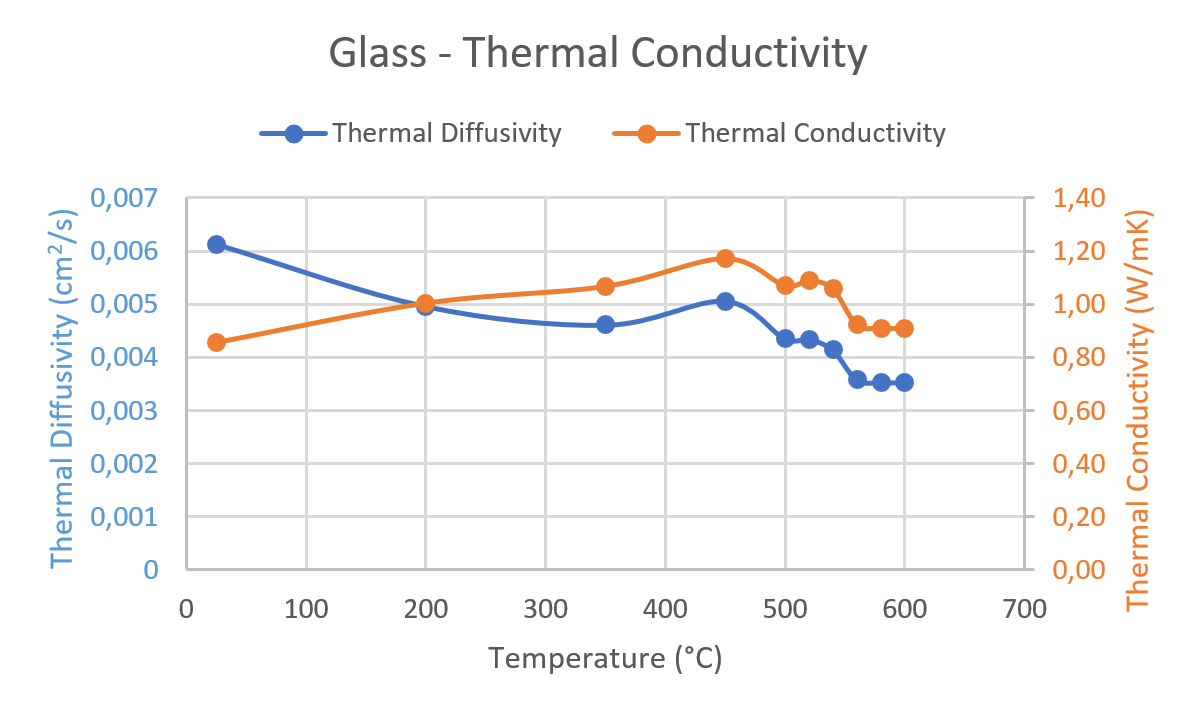
The diagram above shows the measured thermal conductivity and the calculated thermal conductivity as a function of temperature.
The significant decrease in thermal conductivity between 450 °C and 500 °C and between 540 °C and 560 °C, respectively, may be related to the glass transition temperature and the softening point mentioned above.
Appropriate measuring device
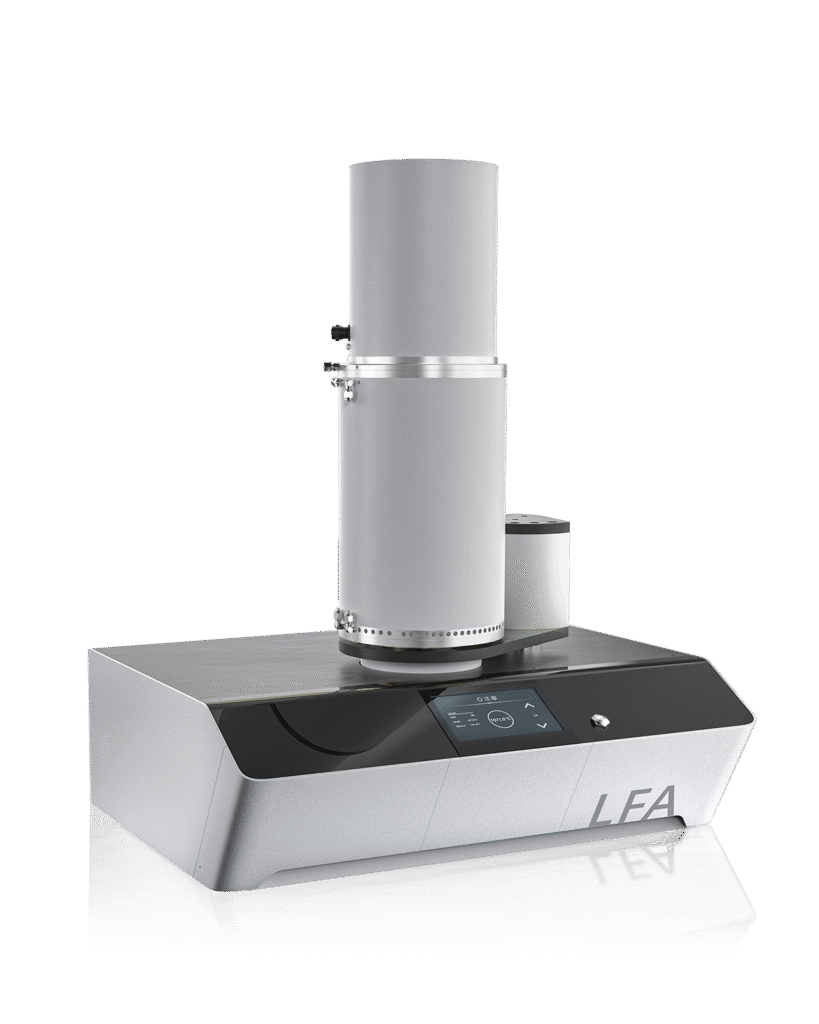
LFA L52
High-performance LaserFlash for measuring thermophysical properties