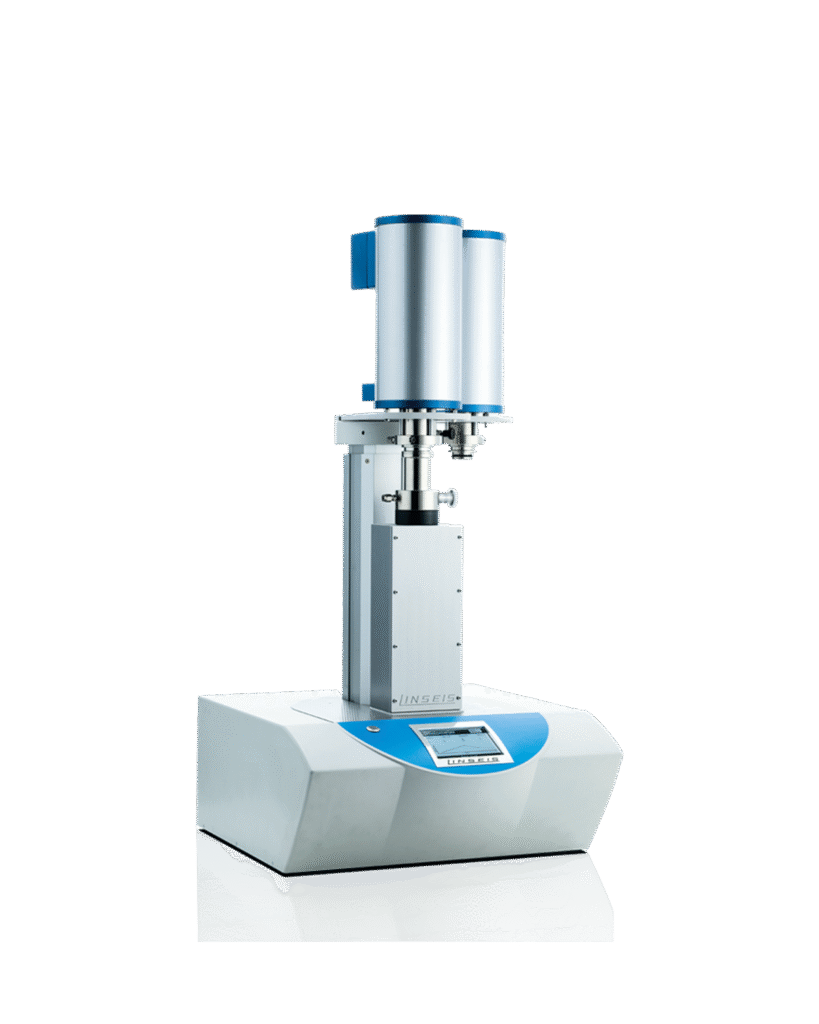
DIL L75 Vertical Single – Glass Rod – Thermal Expansion
Glass is a unique material. It typically exists as an amorphous solid, which means that glass is neither crystalline nor liquid, because its molecules have a fixed structure but no crystal structure.
As a result, glass has properties that are equally unique: transparency, a very low degree of thermal expansion, and a low coefficient of thermal expansion.
Although it may seem at first glance that glass might have a low melting point due to its amorphous nature, it retains its mechanical properties even at high temperatures. This property made it a popular material from the very beginning of human civilizations.
Of course, there are many special types of glass available today, each with a wide variety of properties suited for a range of specific applications. That is why it is important to understand the exact behavior of each type of glass.
A glass rod sample was tested here using push-rod dilatometry . The specimen exhibits linear expansion up to about 575 °C, followed by a sudden increase in expansion.
This is the typical behavior of many glass samples. Immediately before melting begins and before the maximum expansion is reached, the samples exhibit this change in the expansion rate; this is the glass transition temperature.
Once the maximum expansion is reached, the glass begins to melt, so the maximum can be defined as the softening point or melting point.