Thin films and functional coatings are key components of modern technologies. From semiconductors and microelectronic components to sensors and photovoltaics, all the way to optical systems and protective coatings, they enable precisely tunable electrical, thermal, and functional properties.
However, as the layer thickness decreases, the properties of thin films increasingly differ from those of the corresponding bulk material. Microstructure, layer thickness, interfaces, substrates, and fabrication conditions can significantly influence heat and charge transport. Therefore, direct characterization of the actual layer structure is necessary, particularly for complex multilayer systems.
Using specialized measurement systems from LINSEIS, the thermal and electrical properties of thin films and coatings can be precisely determined—from individual functional layers to complex layer stacks and interfaces.
Relevant Questions
What is the thermal conductivity of a thin layer?
How do in-plane and cross-plane heat transfer differ?
How does coating thickness affect thermal properties?
What kind of thermal resistance occurs at material interfaces?
How do the substrate and interfaces affect the measurement results?
How do coating and deposition processes alter material properties?
What are the electrical conductivity and charge carrier mobility of the layer?
How do the properties of thin films change with temperature?
Relevant Material and Process Parameters
Parameter
Meaning
Thermal Conductivity
Evaluation of heat transfer within the thin film
Thermal Conductivity
Characterization of Heat Propagation in a Layered System
Thermal Anisotropy
Distinction Between In-Plane and Cross-Plane Heat Transport
Thermal interfacial resistance
Evaluation of heat transfer between different material layers
Coating Thickness
Effect on thermal and electrical transport properties
Electrical Resistance
Evaluation of the Electrical Conductivity of Functional Layers
Charge Carrier Concentration
Characterization of electronic and semiconducting thin films
Charge Carrier Mobility
Evaluation of the layer’s electrical transport behavior
Measurement Methods for Thin Films and Coatings
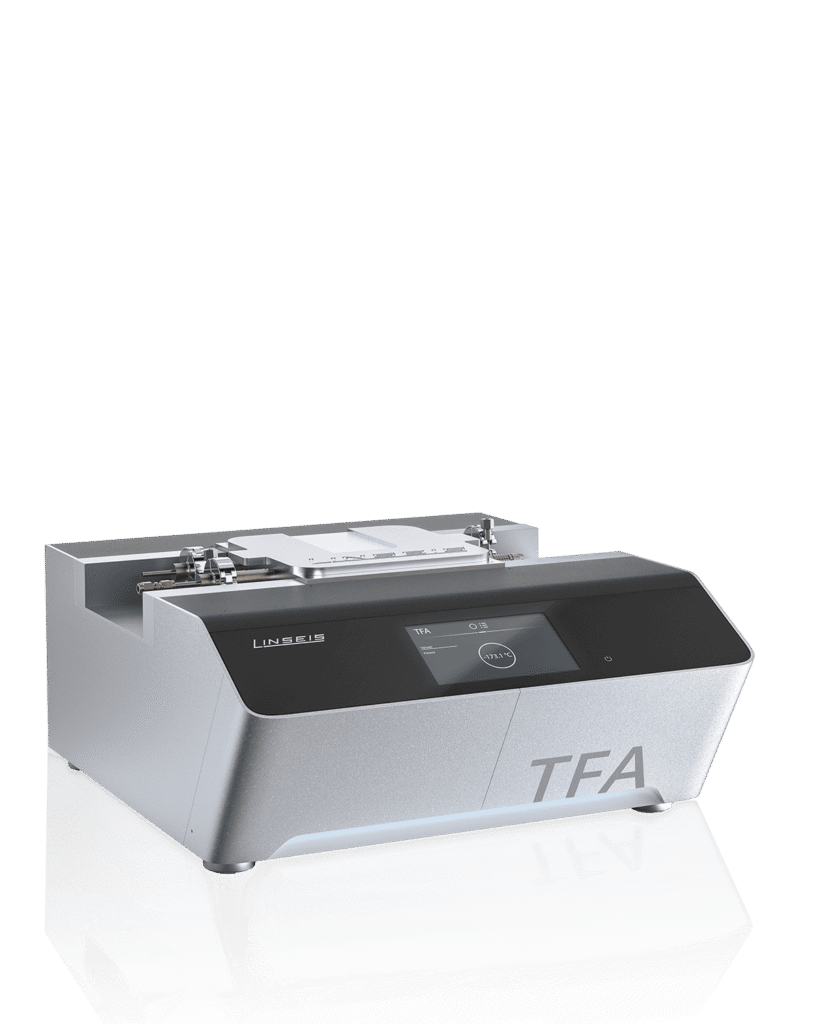
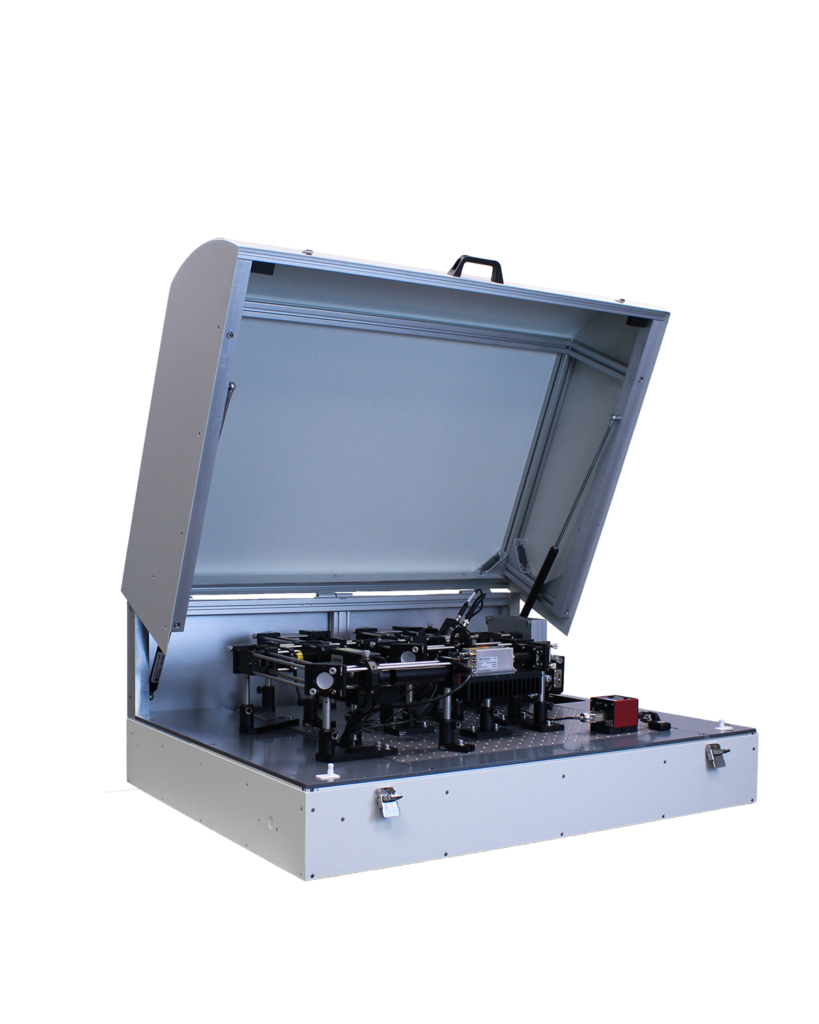
Thin Film Analysis (TFA)
Determination of the thermal properties of thin films using electrical heating and sensing structures.
Case Study: Thermal Characterization of Thin Films
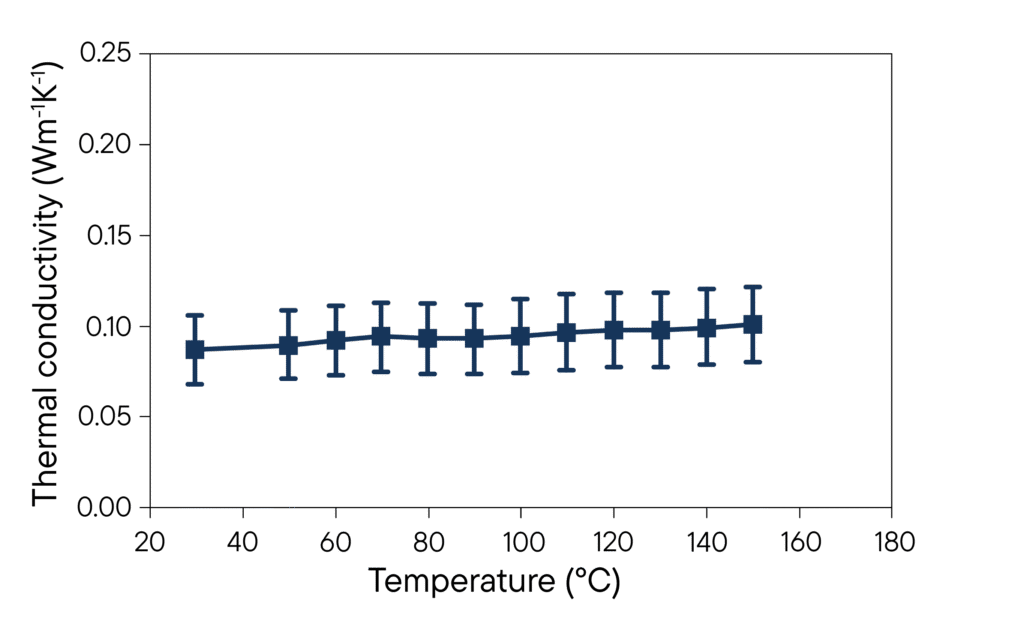
Ultra-low thermal conductivity of organic thermoelectric materials
Measurements taken with the LINSEIS TFA L59 show the exceptionally low and nearly temperature-independent thermal conductivity of an n-doped PTEG-2 thin film. Over the temperature range studied, the thermal conductivity remains below 0.1 W/(m·K) and increases only slightly with rising temperature. This low thermal conductivity is a key factor in the material’s high thermoelectric performance and makes PTEG-2 particularly interesting for flexible electronics, energy harvesting, and the utilization of low-temperature waste heat. Download the white paper to learn more about thermal conductivity measurements and the thermal transport behavior of organic thin films.
Why the Characterization of Thin Films and Coatings Is Crucial
The properties of a thin film cannot be reliably derived from the characteristics of the corresponding bulk material. Film thickness, microstructure, interfaces, and fabrication processes can significantly alter its thermal and electrical behavior.
Direct characterization of the actual layer structure therefore provides crucial information for material development, process optimization, and quality assurance.
The combination of modern analytical methods makes it possible to:
Determination of the Thermal Conductivity of Thin Layers
Characterization of In-Plane and Cross-Plane Heat Transport
Investigation of Thermal Interfaces
Analysis of Complex Multilayer Systems
Determination of Electrical Transport Properties
Characterization of Charge Carrier Concentration and Mobility
Investigation of Temperature-Dependent Material Properties
Comparison of Different Layer Thicknesses and Compositions
Assessment of the Influence of Substrates
Optimization of Coating and Deposition Processes
Applications – New Technologies
TFA L59 - thermoelectric thin film - thermoelectric properties - metals and alloys
As the layer thickness decreases, microstructure, interfaces, and surface effects become increasingly important. As a result, the thermal conductivity and electrical transport properties of a thin film can differ significantly from the known bulk values of the same material.
What is the difference between in-plane and cross-plane thermal conductivity?
“In-plane” refers to heat transfer parallel to the plane of the layer, while “cross-plane” refers to heat transfer perpendicular to the plane of the layer. These two values can differ significantly, particularly in the case of anisotropic materials and multilayers.
Why are thermal interfaces important in thin films?
An additional thermal resistance can arise at the interface between two different materials. In the case of very thin layers, this interfacial effect can account for a significant portion of the system’s total thermal resistance and have a major impact on heat dissipation.
What types of thin films and coatings can be analyzed?
Depending on the measurement method, metallic, dielectric, semiconducting, and other functional thin films, as well as multilayers, can be analyzed. Typical applications include semiconductor technology, microelectronics, sensor technology, photonics, photovoltaics, and functional coatings.
What is the difference between Thin Film / 3-Omega and FDTR?
The 3-Omega method uses an electrical heating and measurement structure to determine the thermal behavior of the sample. FDTR, on the other hand, is based on an optical pump-probe approach and analyzes the temperature-dependent change in reflectivity. The methods thus employ different measurement principles and complement each other in thin-film characterization.
What electrical properties can be studied in thin films?
Hall effect analysis can be used to determine, among other things, the Hall coefficient, carrier concentration, carrier mobility, and electrical resistance. These parameters are particularly relevant for semiconductors and functional electronic layers.
Why is it necessary to take the substrate into account when measuring thin films?
For very thin layers, the thermal behavior of the substrate can have a significant influence on the measured total signal. A suitable measurement and analysis strategy is therefore crucial for reliably distinguishing the properties of the actual layer from the influence of the substrate.