


Table of contents
The development of modern glass materials places the highest demands on analytical methods. Particularly with sensitive high-tech glasses, thin films or microstructured glass ceramics, conventional measuring methods quickly reach their limits. The laser dilatometry has established itself as a pioneering technology that masters these challenges through contactless, high-precision measurements.
Technological basics and measuring principle
The laser dilatometer uses a focused laser beam for non-contact measurement of length changes during defined temperature cycles. The system uses laser triangulation to register microscopic dimensional changes with a resolution down to the nanometer range. This method completely eliminates systematic errors caused by mechanical contact and enables even the most sensitive materials to be analyzed without any interference.
The versatility of the method is demonstrated by its compatibility with a wide range of sample geometries and sizes. Even materials with irregular shapes, low mass or special surface properties can be reliably characterized (FunGlass, 2024). Variable atmosphere control under air, inert gas or vacuum extends the range of applications to reactive glass materials.
Precise determination of critical glass parameters
Glass transition temperature (Tg)
The determination of the glass transition temperature is carried out via the characteristic kink in the expansion diagram. Modern evaluation algorithms such as the two-tangent method, non-linear fits or differential analytical methods enable precise quantification even for complex transitions (Linseis, 2024b). The high data quality of the laser dilatometer enables differentiated analyses that cannot be achieved with conventional methods.
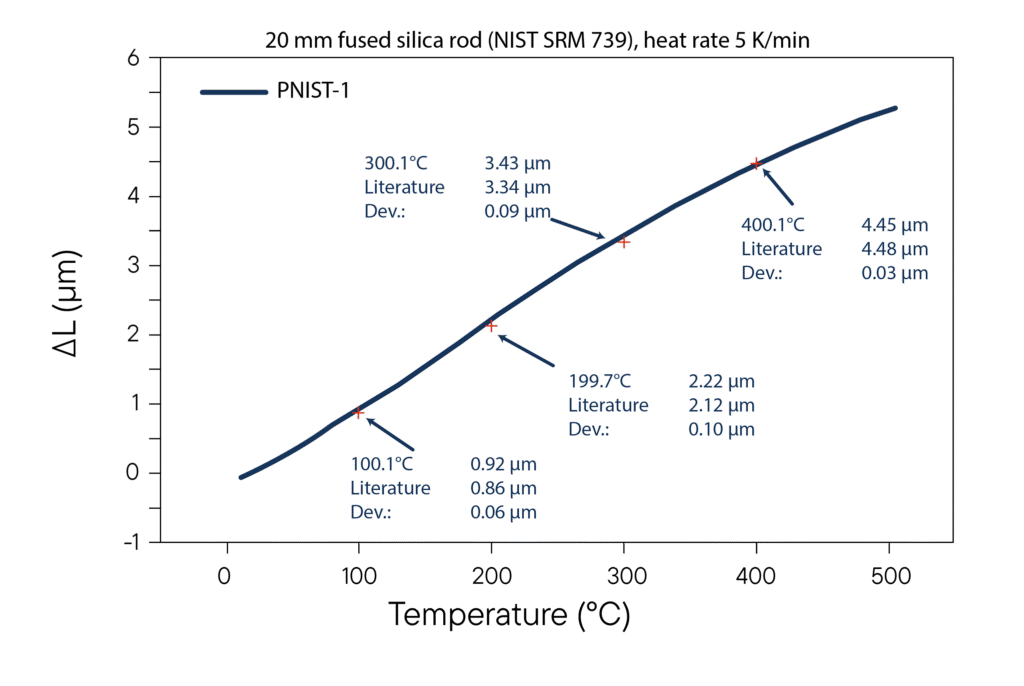
The dilatometric investigation of a 20 mm long fused silica reference rod (NIST SRM 739) shows a practical example of the achievable measurement accuracy. At a heating rate of 5 K/min, the thermal change in length was determined over the temperature range up to 500 °C. The measured values agree very well with literature data; the deviation is in the range of only 0.03 µm to 0.26 µm over several temperature points. This result confirms the high precision of interferometric or laser-based dilatometry for the characterization of glassy materials.
Softening point and other thermal properties
The softening point manifests itself as the maximum of the first derivative of the change in length and can be identified with particular precision using laser dilatometry. This high resolution proves to be decisive in the characterization of multi-phase or gradual glass transitions in modern high-tech glasses.
In addition, the method enables the detailed investigation of further phenomena such as fictitious temperature, structural relaxation, anisotropic expansion as well as reversible and irreversible transformations (FunGlass, 2024). Modern analysis algorithms support the precise quantification of these complex thermal properties (ScienceDirect, 2024).
Fields of application in industry and research
Contactless laser dilatometry has proven to be indispensable in various high-tech areas:
Optical glasses and glass fibers benefit from the ability to investigate stress relief and relaxation processes under precisely defined atmospheres without mechanical influences (FunGlass, 2024). This precision is essential for the quality assurance of optical components.
Biomedical glasses with the smallest sample sizes and specific optical properties require non-contact analysis for the development of implant glasses and biocompatible materials.
Electronic applications such as conductive track glasses benefit from automatable data integration and high precision, which significantly accelerates R&D cycles.
Scientific validation and standardization
Laser dilatometry is defined in international standards such as ASTM E228 and DIN/ISO 7884 as a reference method for glass, ceramics and composites. Supplementary standards such as ASTM E1356 for DSC-based and ASTM E1545 for thermomechanical Tg determination (ASTM International, 2023; ASTM International, 2022) and ISO 11359-2 for dilatometric measurements (ISO, 2019) form the normative foundation of modern glass characterization. The absence of systematic contact errors enables international comparability of results and makes the method the gold standard for sophisticated material characterization.
Integration into modern smart lab environments through digital data evaluation and networking options supports modern laboratory and production processes.
Comparison with conventional dilatometry methods
Traditional push rod dilatometers or optical methods quickly reach their limits with sensitive glass materials. Mechanical contact methods can introduce stresses into the sample that distort the measurement result or even lead to damage in the case of thin layers. The following comparison illustrates the advantages of laser dilatometry:
Push rod dilatometry:
- Mechanical contact can affect the sample
- Limited resolution (typically 10-50 nm)
- Problematic with soft or fragile materials
- Restricted sample geometry
Optical dilatometry (classic):
- Depending on sample surface and transparency
- Less precise with small samples
- Limited temperature control
- Limited resolution (0.1 – 0.5 µm)
Laser dilatometry:
- Completely contactless
- Nanometer resolution
- Versatile sample geometries possible
- Precise atmosphere control
Practical measurement tips and sample preparation
For optimum measurement results, a few practical aspects must be taken into account:
Sample preparation: The sample surface should be suitable for stable laser focusing. For very smooth or transparent surfaces, a minimal surface treatment (e.g. a slight roughening of the surface) can improve the signal quality.
Temperature control: The heating rate significantly influences the resolution of the thermal transitions. Slower heating rates (1-5 K/min) enable more precise Tg determinations, while faster rates are suitable for screening applications.
Atmosphere selection: The choice of measuring atmosphere is particularly critical for oxidation-sensitive glasses or glass-ceramics. Inert gas atmospheres prevent unwanted chemical reactions during the measurement.
Data evaluation: Modern software enables automated evaluations, but critical transitions should be validated manually, especially for complex glass systems with multiple transitions.
Economic considerations and ROI
The investment in a laser dilatometer is amortized by various factors:
Time savings: Automated measurement sequences and precise results on the first test reduce repeat measurements and accelerate development cycles.
Sample loss: Since no mechanical damage occurs, valuable or difficult-to-produce samples can be measured several times.
Quality assurance: The high level of reproducibility reduces complaints and improves product quality in the long term.
Research efficiency: The ability to characterize previously unmeasurable materials opens up new fields of research and product development. University research institutions such as the Plasma Forming Laboratory at Florida International University use this technology to investigate phase transitions and thermal expansion coefficients (FIU, 2023).
Technical challenges and innovative solutions
Special algorithms and adapted laser optics minimize reflection artefacts even with highly transparent or highly polished glass. Progressive miniaturization makes laser dilatometers ideal for the analysis of micro components, fibres and glass-based MEMS components.
The challenge of transparency: high-purity optical glass reflects the laser beam only minimally. Modern systems compensate for this with adaptive laser power and signal enhancement algorithms.
Miniaturization: With the increasing miniaturization of components, the demands on measurement resolution are growing. Current laser dilatometers already achieve resolutions of less than 1 nm and can therefore detect even the smallest thermal effects.
Future prospects and development trends
Laser dilatometry is constantly evolving. Current trends include:
Artificial intelligence: Machine learning algorithms are increasingly supporting the automatic detection and classification of thermal transitions, especially in complex multi-component systems.
Multisensor integration: Combination with other analysis methods such as DSC or TMA in one device system for comprehensive material characterization. Current research by the American Ceramic Society shows promising approaches for combining different thermal analysis methods (American Ceramic Society, 2024).
Digital twins: Integration of measurement data into digital material models for predictive material development and process optimization.
Industry 4.0 connection: Complete integration into smart factory concepts with real-time data transfer and automatic quality assessment.
Conclusion
Laser dilatometry is increasingly establishing itself as a standard procedure in the characterization of sensitive glass materials. Its combination of contactless measurement, extreme precision and versatility makes it an indispensable tool for the development and quality assurance of modern high-tech glasses. The international standardization and scientific recognition underline the importance of this innovative analysis technology for the future of glass research and development.
References
- American Ceramic Society. (2024). Modeling teaches old dogs new tricks: Viscosity predictions from dilatometry and DSC. Ceramic Tech Today. Retrieved from https://ceramics.org/ceramic-tech-today/viscosity-predictions-from-dilatometry-and-dsc/
- ASTM International. (2022). ASTM E1545 Standard Test Method for Assignment of the Glass Transition Temperature by Thermomechanical Analysis. Retrieved from https://store.astm.org/e1545-22.html
- ASTM International. (2023). ASTM E1356 Standard Test Method for Assignment of the Glass Transition Temperatures by Differential Scanning Calorimetry. Retrieved from https://www.astm.org/e1356-23.html
- FIU – Florida International University, Plasma Forming Laboratory. (2023). Dilatometry Analysis of materials. Retrieved from https://pfl.fiu.edu/dilatometry-analysis-of-materials
- FunGlass – Centre for Functional and Surface-Functionalized Glass. (2024). FunGlass research project. Retrieved from https://www.funglass.eu
- ISO – International Organization for Standardization. (2019). ISO 6721-11:2019 – Plastics – Determination of dynamic mechanical properties – Part 11: Glass transition temperature. Retrieved from https://www.iso.org/standard/74988.html
- ScienceDirect. (2024). Dilatometry – an overview. ScienceDirect Topics. Retrieved from https://www.sciencedirect.com/topics/materials-science/dilatometry
