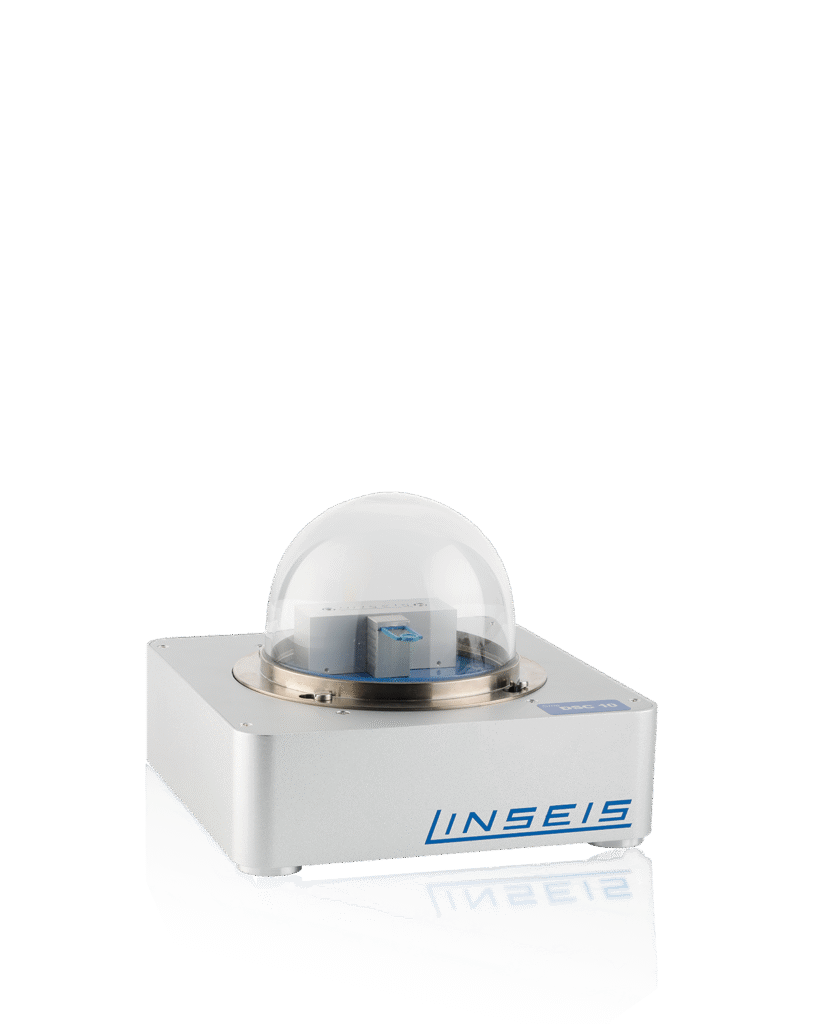
The Chip-DSC, when used in combination with a UV/LED light source, is a powerful tool for characterizing fast-curing resin systems [L. Gonzales, University of Bayreuth].
Since the chip DSC allows optical access to the sample during the measurement, it can be equipped with optical detectors such as cameras and spectrometers, as well as with light sources such as UV/LED systems for curing and hardening experiments, to simulate hardening processes in the DSC crucible.
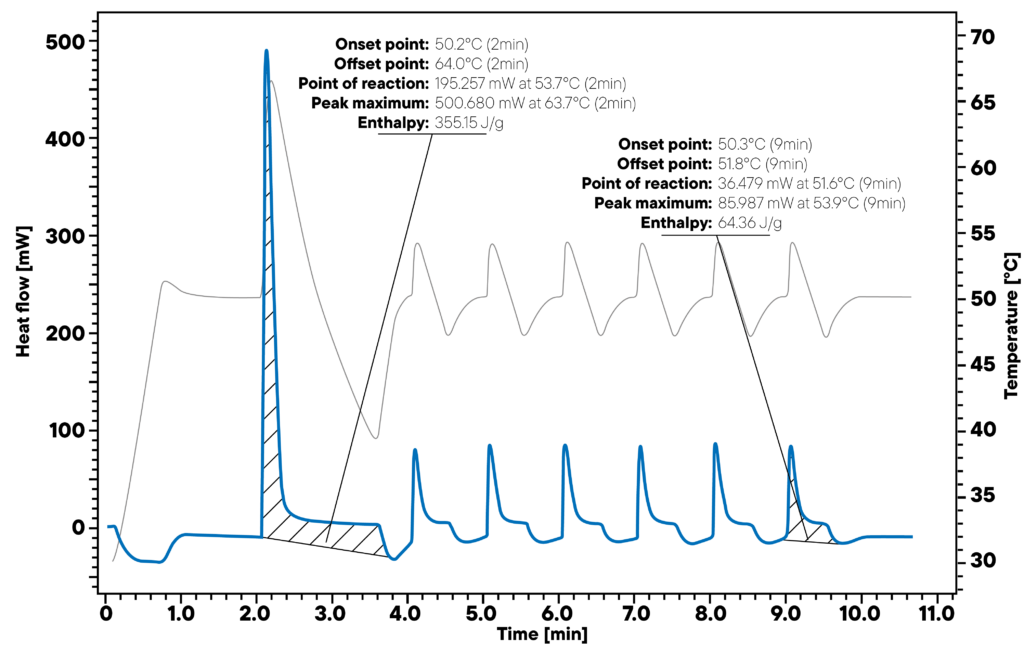
In this particular case, a mixture of photo-curable acrylate and thermosetting epoxy was used, and approximately 10 mg of the material was placed in an open crucible on a Chip-DSC 10 (Chip-DSC L66 Advanced)/Photo-DSC and irradiated with several UV light pulses until no further changes in peak area were observed.
The difference between the first and last irradiation peaks (when the area under the peak reaches a plateau, i.e., it is assumed that no reaction is taking place) is calculated to determine the heat of reaction and the enthalpy for the UV-curing component and to derive a conversion curve.