


Table of contents
Universal chemical resistance meets thermal stability
Perfluoroalkoxy (PFA) is a high-performance fluoropolymer that combines almost universal chemical resistance with high thermal stability. thermal stability up to a continuous service temperature of 260 °C and therefore offers extremely high process reliability in critical process environments (Lorric, 2024).
Structural properties: crystallinity and molecular structure
PFA is a semi-crystalline fluoropolymer: The perfluorinated, linear chain with side alkoxy groups enables the formation of crystalline domains, while amorphous areas provide flexibility and toughness. Typically, a moderate crystallinity is typically set in order to achieve a combination of dimensionally stable, rigid structures and sufficient ductility, for example for hoses, liners and films in chemical processes (Laird Plastics, 2026).
The crystalline domains are central to the high heat resistance and the pronounced chemical resistance, as densely packed, highly fluorinated chains offer hardly any surface for reagents to attack. In the amorphous domains, the mobility of the chains is also severely restricted by the voluminous fluorine atoms, which reduces the tendency to creep and stress cracking under chemical and thermal stress. Process parameters such as cooling rate, post-crystallization and thermal history can specifically shift the ratio of crystalline to amorphous fractions – an important lever for engineers to tailor stiffness, transparency and thermal cycling resistance to applications (Lorric, 2024).
Thermal characteristics: Melting point and temperature resistance
PFA has a comparatively high melting melting point in the range of around 285-305 °C, which is significantly higher than many engineering thermoplastics and also higher than FEP. This reflects the high cohesive energy of the perfluorinated chains and the efficient packing in the crystalline areas (Laird Plastics, 2026).
In practice, the high melting point allows continuous operation up to around 260 °C, with brief peaks above this temperature, without any relevant structural degradation effects occurring. For users, this means Reactor linings, transfer lines and valve seats can be operated at elevated process temperatures and during CIP/SIP cycles without embrittlement or significant dimensional changes. Thermal analyses such as DSC provide not only the melting point itself, but also information about the enthalpy of fusion and thus the effective crystallinity, which is particularly important for quality control and material approval.
From a thermal point of view, PFA is specified for an application range of around -200 °C to +260 °C and shows high dimensional and property stability in this window (Lorric, 2024). Even with repeated thermal cycles between ambient temperature and the upper application temperature, mechanical properties and chemical inertness are largely retained. Degradation processes typically only set in well above the recommended long-term service temperature, whereby TGA investigations show that the main degradation begins in a higher temperature window and is accompanied by a loss of mass.
Glass transition: ductility even at low temperatures
In contrast to many other thermoplastics, PFA does not exhibit a pronounced glass transitionwhich would be clearly detectable in standard DSC measurements; the corresponding change in the specific heat capacity is very small. In practical terms, this means that the material does not exhibit the typical brittle “glass state” in the technically relevant temperature range, but continues to show ductile behavior at low temperatures (Insulation Tubing Manufacturer, 2025).
For applications in low-temperature processes or cryogenic media, this results in an advantage over classic amorphous plastics, whose impact strength decreases significantly near and below the glass transition temperature. In material characterization, dynamic or mechanical spectroscopy methods are often used in addition to DSC to quantify relaxation-based phenomena below the melting range for more precise detection of subtle transitions.
Material variants: Copolymers and modified grades
PFA is structurally a copolymer, usually of tetrafluoroethylene (TFE) and perfluorinated alkoxy vinyl ethers, whereby the type and quantity of alkoxy segments control the processability and properties (Laird Plastics, 2026). Melt viscosity, crystallinity, transparency and flexibility can be specifically varied via the copolymer composition, for example for thin films, extruded hoses or injection-molded precision components.
In addition to standard PFA for general chemical applications, there are types with optimized weldability, increased transparency or improved stress crack resistance, which are used in particular in the semiconductor and pharmaceutical industries. Filled and modified PFA compounds (e.g. with glass or carbon fibers) also enable higher rigidity and reduced thermal expansion without significantly compromising media resistance. There are different types of PFA on the market, which are primarily differentiated by molecular weight, copolymer composition and processing focus: Grades for standard extrusion (hoses, tubes, films), injection molding grades for precision components and special grades with reduced melt viscosity for complicated geometries or thin-walled areas.
There are also high-purity PFA grades with tightly controlled metal ion contents and defined particle purity, which are used in particular in the semiconductor and pharmaceutical industries for media guidance systems (Lorric, 2024). In addition, there are also electrically modified grades, such as slightly conductive compounds for discharging electrostatic charges in potentially explosive or high-purity environments, without having to sacrifice chemical inertness.
Resistance profile: Chemical, UV and mechanical
This inertness prevents corrosion of metallic substrates, minimizes metal ion contamination and enables use in high-purity processes, for example in semiconductor, pharmaceutical and fine chemical production.
PFA also exhibits very good UV stability due to the strong C-F bond, so that outdoor and radiation applications (e.g. UV-disinfected media or outdoor installations) are possible without significant yellowing or mechanical degradation (Insulation Tubing Manufacturer, 2025). From a mechanical point of view, the modulus of elasticity is in the range of higher engineering thermoplastics, with high elongation at break and excellent crack growth resistance, which is reflected in long flexural fatigue strength and low tendency to stress corrosion cracking in aggressive media. For designers, this means that PFA components retain their function even under combined chemical, thermal and mechanical stress over long periods of time.
Thermal analysis: characterization with precise measuring methods
Thermal analysis methods play a central role in the development, quality assurance and failure analysis of PFA materials. Simultaneous thermal analysis (STA) systemsthe TGA and DSC in one device, enable the simultaneous detection of melting and crystallization behavior, glass transitions (if detectable), thermal stability and onset of decomposition including mass loss – ideal for evaluating formulations, process windows and aging states of PFA.
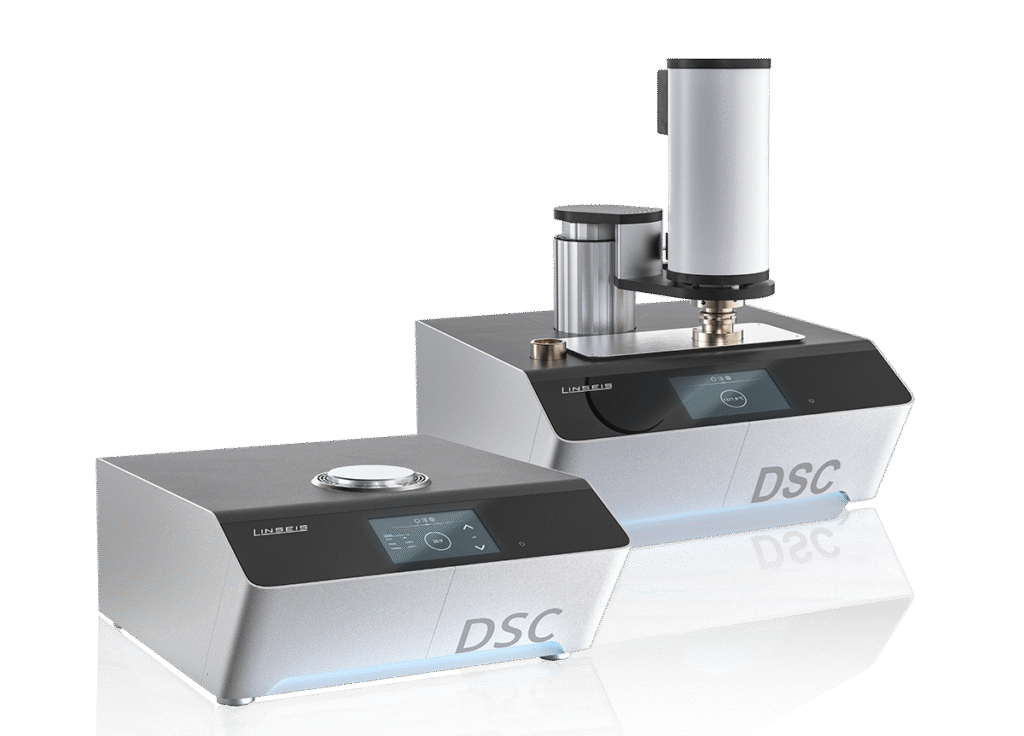
In addition, stand-alone DSC and TGA systems provide detailed insights into the degree of crystallinity, melt enthalpy and oxidation stability, for example to optimize extrusion and welding parameters or to approve batches in the incoming goods department. This provides engineers and laboratory teams with end-to-end characterization options – from the basic development of new PFA types to routine process monitoring – without having to compromise on data accuracy and reproducibility.
References
- Lorric (2024):
PFAMaterial Characterization – Chemical Resistance and Material Properties.
Available at: https://www.lorric.com/en/Articles/Material/plastic/material-chemical-resistance-chart-PFA. - Laird Plastics (2025):
PFAPlastic Guide: Properties, Uses & Advantages . Available at: https://lairdplastics.com/resources/pfa-plastic-guide-properties-uses-advantages-2025/. - Lorric – Material Characterization (2024):
Chemical and Physical Properties of PFA – Temperature Range and Chemical Resistance.
Available at: https://www.lorric.com/en/Articles/Material/plastic/material-chemical-resistance-chart-PFA. - Insulation Tubings / Forbest Manufacturing (2024):
PFA Properties, Benefits and Uses. Available at: https://www.insulation-tubings.com/info/pfa-properties-benefits-and-uses-102686013.html.
