Bismuth telluride is the only NIST-certified reference material for the Seebeck coefficient. However, it can only be used up to a maximum temperature of 120 °C.
Constantan can be used at temperatures up to 800 °C and can therefore serve as a high-temperature calibration material. The slope method, in which different temperature gradients are applied at specific temperatures and the Seebeck coefficient is calculated from the slope, offers improved accuracy.
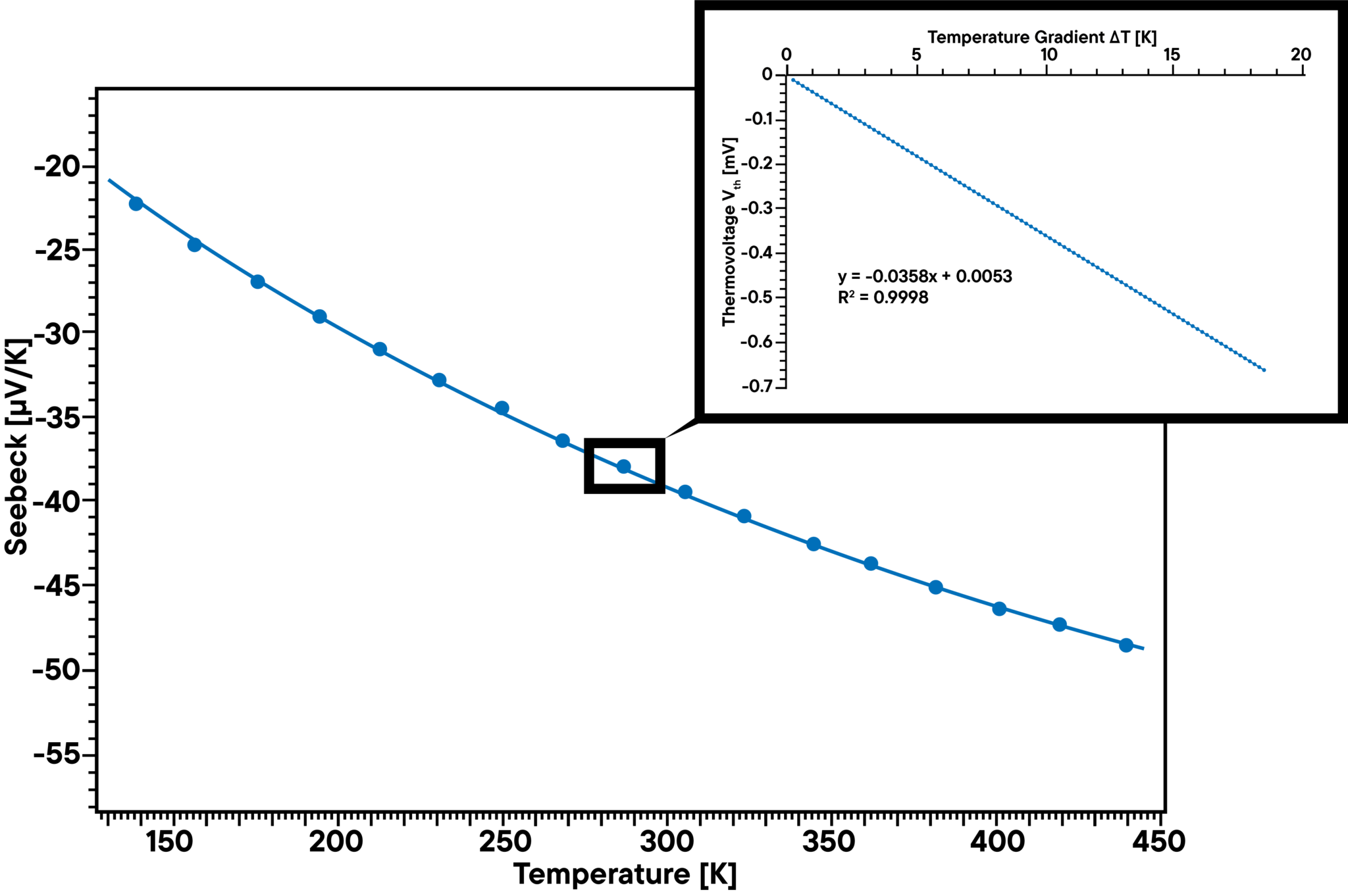
Measurement of the Seebeck coefficient on a constantan reference sample from -143 °C to +172 °C (130 K to 445 K). The Seebeck coefficient is measured for each temperature data point using the slope method.
Several temperature gradients were applied to the sample at different temperatures, and the Seebeck coefficient was calculated from the slope of the resulting straight line.
The result can be plotted as a relative Seebeck coefficient against Pt or as an absolute Seebeck coefficient.